
Country
Tax in Slovakia Sourced summary, not advice.
 Tax in Slovakia Sourced summary, not advice.
Tax in Slovakia is administered by Financial Administration of the Slovak Republic (Finančná správa Slovenskej republiky). This page gives the headline tax rates on record for Slovakia, the next filing deadline and the main rules. Each figure carries its date and its official source, or is marked source pending.
SK notes on this page are the question-and-answer record already researched for SK. Read the cited government page before treating a figure as current, and speak with a qualified professional in SK about a filing.
What statutory framework governs cryptocurrency taxation in Slovakia?
Slovakia taxes income from virtual currency disposals under Act No. 595/2003 Coll. on Income Tax (Zakon o dani z prijmov), administered by the Financne riaditelstvo SR (Financial Directorate of the Slovak Republic). Virtual currency income for a non-entrepreneur individual is classified as "other income" under Section 8(1)(t) of the Income Tax Act and is included in the general tax base for the calendar year in which the disposal takes place.
A disposal (predaj) is defined broadly: exchange of virtual currency for any asset, exchange for another virtual currency, exchange for services, or any paid transfer. No holding-period exemption currently exists; all disposals regardless of how long the asset was held enter the standard progressive tax base. Slovakia country overview
What are the current Slovak crypto income tax rates?
For individual non-entrepreneurs in the 2025 and 2026 tax years, income from virtual currency disposals is taxed at 19% on the portion of total taxable income not exceeding EUR 48,441.43 and at 25% on any excess above that threshold. These thresholds are indexed annually to 176.8 times the subsistence minimum. A 15% mandatory health insurance contribution (zdravotne poistenie) is separately imposed by the health insurer on the assessment base derived from crypto income, bringing the effective combined ceiling to approximately 40% for higher earners. Deductible expenses under Section 19(2)(v) are capped at the amount of the disposal income -- losses from virtual currency cannot be recognised against other income or carried forward. The Income Tax Act specifies that acquisition cost, transaction fees, and documented incidental costs of acquisition qualify as deductible expenses.
What happened to the proposed 7% reduced rate?
The Slovak National Council (National Parliament) passed an amendment to the Income Tax Act in June 2023 that would have introduced, from January 1, 2024, a 7% special tax rate on virtual currency held by an individual for more than one year, with a complete exemption from health insurance contributions.
Sponsored. We may earn a commission if you sign up through these links, at no cost to you. How we earn
The same amendment would have excluded crypto-to-crypto exchanges from the definition of a taxable disposal, introduced a EUR 2,400 annual micro-payment exemption for goods and services paid in crypto, and deferred taxation of staking and mining income until the point of disposal. Bloomberg Tax reported the original amendment was designed to attract crypto investors and align Slovakia with more competitive European frameworks. However, following Slovak parliamentary elections in autumn 2023, the newly elected government reversed the policy.
On December 19, 2023, the National Council passed consolidation package Act No. 530/2023 Coll., which expressly repealed the crypto definitions and new rules introduced earlier that year before they could take effect. Highgate law firm (Bratislava) noted the reversal in a published analysis, observing that affected taxpayers reverted to the 19%/25% plus health levy structure.
What triggers a taxable disposal in Slovakia?
Under the currently applicable rules in Act No. 595/2003 Coll., a taxable sale of virtual currency occurs in any of the following situations: (1) exchange of virtual currency for fiat currency such as EUR, USD, or any other legal tender; (2) exchange of virtual currency for another virtual currency or stablecoin; (3) exchange of virtual currency for goods or services; (4) any other paid transfer of virtual currency.
Income is recognised in the tax period (calendar year) when the exchange or transfer occurs, and must be valued at the market price on the date of disposal as established by the taxpayer from a publicly accessible market under Section 27(13) of the Accounting Act No. 431/2002 Coll. Payments for goods and services denominated in crypto are therefore fully subject to income tax at standard rates with no de minimis threshold. The EUR 2,400 annual micro-payment exemption that would have applied from 2024 was part of the repealed amendment and does not apply. See also the Slovakia country overview for general tax residency context.
How are mining and staking income treated under Slovak tax law?
Mining and staking income follow a two-stage framework preserved across legislative iterations. Receipt of newly created virtual currency through mining or staking does not immediately trigger income tax recognition for a non-entrepreneur individual. Taxation arises at the point of disposal -- when the mined or staked coins are sold, exchanged, or otherwise transferred for consideration. At that point, the income enters the Section 8(1)(t) "other income" base at the market value on the disposal date.
The deductible expense basis for mined crypto includes documented electricity costs, equipment depreciation allocable to the mining activity, and transaction fees. Staking rewards use fair market value at acquisition as the cost basis for the subsequent disposal calculation. This deferred-recognition approach for mining and staking was part of the original June 2023 amendment and survived the December 2023 repeal -- it was not a new provision but reflected prior Financial Directorate interpretive practice under the existing Act 595/2003 Coll. framework.
What is DAC8 and how does it affect Slovak crypto holders?
Council Directive 2023/2226/EU (DAC8) requires EU member states to collect and automatically exchange information on crypto-asset transactions from crypto-asset service providers. The Slovak Parliament passed the implementing bill on June 10, 2025. The reporting obligation for crypto-asset service providers (exchanges, custodial wallet providers, brokers) takes effect from January 1, 2026, with the first automatic exchange of information between EU member states scheduled for 2027. Under DAC8, providers must collect and report customer identification, transaction volumes, and disposal proceeds for each reportable crypto-asset transaction. Slovak residents using foreign exchanges that fall outside DAC8 scope should self-report all crypto income in their annual tax return. The Financne riaditelstvo SR processes annual tax returns due by March 31 following the tax year, with extension to June 30 available through a registered tax representative. Consulting a qualified daňový poradca (registered tax consultant) listed with the Slovak Chamber of Tax Consultants (SKDP) is appropriate for complex crypto portfolios or cross-border exchange usage.
This page presents general information on Slovak tax law sourced from the Financne riaditelstvo SR, Act No. 595/2003 Coll., Act No. 530/2023 Coll., and published analyses by Bloomberg Tax and Slovak law firms. It does not constitute professional tax guidance. Individual circumstances vary; a qualified Slovak tax professional should be consulted before making any disclosure or reporting decisions.
Slovakia crypto taxation 2026 -- Act 595/2003 Coll. income tax framework, the repealed 7% amendment, and DAC8 reporting
Slovakia taxes crypto disposals as personal income under Act 595/2003 Coll. at 19% (up to EUR 48,441.43) or 25%, plus a 15% health insurance levy. A 7% reduced rate for crypto held over one year was passed in June 2023 but repealed December 19, 2023 before taking effect. DAC8 provider reporting begins January 2026.
Is there a reduced 7% crypto tax rate in Slovakia?
No. A 7% reduced rate for crypto held over one year was passed in June 2023 but was repealed by Act No. 530/2023 Coll. on December 19, 2023, before it took effect. Current Slovak law taxes all virtual currency disposals as ordinary income at 19% or 25% plus a 15% health insurance levy, regardless of how long the asset was held.
What is the taxable event for crypto in Slovakia?
Under Act No. 595/2003 Coll. as currently in force, taxable events include any exchange of virtual currency for fiat currency, for goods or services, for another virtual currency or stablecoin, or any other paid transfer. Income is recognised in the calendar year the exchange occurs, valued at market price on the transaction date from a publicly accessible market.
Does Slovakia tax crypto-to-crypto swaps?
Yes. Under the current rules, exchanging one virtual currency for another (for example, bitcoin to ether) is included in the definition of a taxable disposal under Section 8(1)(t) of the Income Tax Act. The proposed exemption for crypto-to-crypto swaps was contained in the June 2023 amendment that was repealed in December 2023 and did not take effect.
How is staking income taxed in Slovakia?
Staking rewards are not taxed when received. Taxation arises at the point of disposal -- when the staked coins are sold or exchanged for consideration. At disposal, the income enters the other-income base at market value on the disposal date. The cost basis for calculating the gain is fair market value at the time the staking reward was received.
When does DAC8 crypto reporting start in Slovakia?
Slovakia's DAC8 implementing bill was passed on June 10, 2025. Crypto-asset service providers must begin collecting and reporting transaction data from January 1, 2026, with the first automatic exchange of information with other EU member states due in 2027. Slovak residents using non-EU exchanges should self-report all crypto income in their annual tax return filed by March 31.
Frequently asked
Who is the Slovak tax authority?
Financne riaditelstvo Slovenskej republiky (Financial Directorate of the Slovak Republic), under the Ministry of Finance. Filings flow through www.financnasprava.sk. CA Slovakia regulated by Slovak Chamber of Auditors and Tax Advisors.
When is the Slovak annual return due?
Personal income tax returns due 31 March of year following calendar tax year (extendable). Corporate annual returns due 31 March. VAT monthly above threshold by 25th of following month, or quarterly.
Who is a Slovak tax resident?
Tax residents either maintain permanent residence in Slovakia OR habitual abode (at least 183 days physical presence in calendar year). Residents taxed on worldwide income; non-residents on Slovak-source income at flat rates.
What are the Slovak personal income tax rates?
Two brackets for 2024: 19 percent up to 176.8x subsistence minimum (~EUR 47,537); 25 percent above. Personal allowance EUR 5,646. Dividends 7 percent WHT. Social security 13.4 employee + 35.2 employer.
How does Slovakia's corporate tax work?
21 percent for 2024. 2024 Consolidation Package raised to 24 percent from 1 January 2025 above EUR 5m turnover; 10 percent micro-rate up to EUR 60,000. Pillar Two QDMTT/IIR from 31 December 2023; UTPR from 31 December 2024. Tax losses 5 years.
What is the Slovak VAT rate?
Standard DPH is 23 percent from 1 January 2025 (previously 20 percent). The old 10 percent reduced rate was abolished: reduced rates are now 19 percent and 5 percent (basic foods, accommodation, medicines, books). Registration: EUR 50,000 previous-calendar-year turnover, or immediate at EUR 62,500 in-year. EU OSS/IOSS applies.
From TaxProsRated · our own product
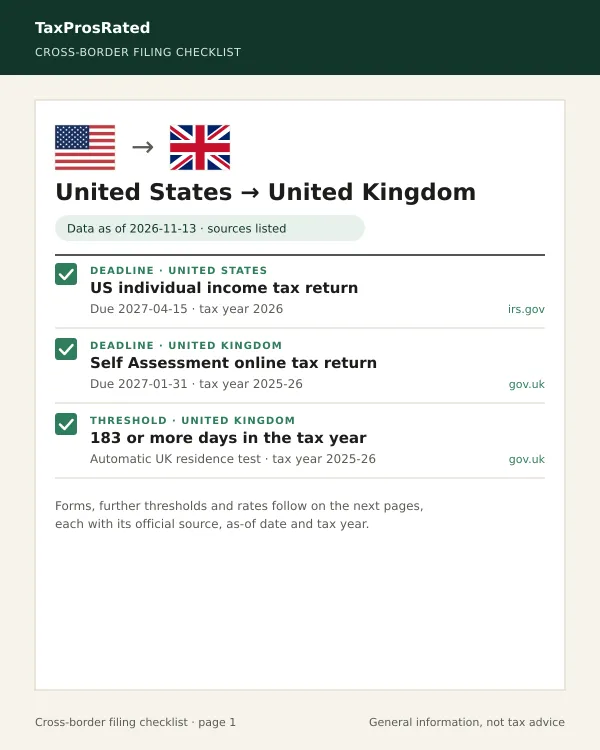
Cross-border filing checklist
- A PDF and a web copy of the checklist for the country pair you choose
- Filing deadlines for both countries, each with the official source URL and as-of date
- The forms named by each tax authority, with a link to the authority's own page
$29 one-time · One payment, no renewal. Tax, if any, is shown at checkout.
More countries in this region · All jurisdictions · Slovakia filing deadlines · Slovakia in the tax rates index · Cross-border filing checklist
Change log
- Country summary updated
- Country summary updated
- Reviewed against Financial Administration of the Slovak Republic (Finančná správa Slovenskej republiky)
Sources
The figures, dates, and rules on this page are sourced from the documents listed below. Where two sources disagree, both are listed.
Important disclaimer
Informational only — not tax advice. This page summarises publicly available information about tax in Slovakia as of November 2026. Tax laws change, individual circumstances vary, and the application of any rule depends on your specific facts.
TaxProsRated does not provide tax, legal, accounting, or financial advice. Before acting on anything you read here, consult a qualified tax professional licensed in your jurisdiction (in the US: CPA, Enrolled Agent, or attorney; in the UK: CIOT- or ATT-qualified adviser; in Australia: TPB-registered tax agent; elsewhere: a locally-licensed equivalent). TaxProsRated, its operators, and its contributors disclaim all liability for action taken in reliance on this page.