
Country
Tax in Bulgaria Sourced summary, not advice.
 Tax in Bulgaria Sourced summary, not advice.
Bulgaria's National Revenue Agency (NAP / Natsionalna Agentsiya za Prihodite) administers a flat 10% personal income tax — one of the EU's lowest — alongside a flat 10% corporate income tax and standard VAT (DDS) at 20%. Tax in Bulgaria is administered by National Revenue Agency (Natsionalna Agentsiya za Prihodite — NAP).
Who is the tax authority?
The National Revenue Agency — Natsionalna Agentsiya za Prihodite (NAP) — administers Bulgaria's tax system. NAP operates under the Ministry of Finance through Sofia headquarters, regional directorates, and a dedicated Large Taxpayers and Insurers Office.
Customs matters fall under a separate agency: Agentsiya Mitnitsi (Customs Agency). Filings for most taxes go through the NAP electronic services portal at nra.bg.
The core legal framework rests on four statutes: the Personal Income Taxes Act (ZDDFL), the Corporate Income Tax Act (ZKPO), the VAT Act (ZDDS), and the Tax-Insurance Procedure Code. EU Directive 2022/2523 (Pillar Two) is transposed via successive amendments to the ZKPO.
What is the tax year and when are returns due?
Bulgaria's tax year is the calendar year (1 January to 31 December) for both individuals and most companies. Returns and payment deadlines vary by tax type.
Who counts as a Bulgarian tax resident?
Under Article 4 of the ZDDFL, a person is a Bulgarian tax resident if any one of four tests is met: maintaining a permanent address in Bulgaria; physically present more than 183 days in any 12-month period; posted abroad by a Bulgarian state entity; or maintaining their centre of vital interests in Bulgaria.
Sponsored. We may earn a commission if you sign up through these links, at no cost to you. How we earn
Residents pay tax on worldwide income. Non-residents pay tax only on Bulgarian-source income at applicable flat rates.
OECD Model tie-breaker rules apply under treaty when dual residency arises. Residency is assessed per tax year — arriving mid-year starts the 183-day count from that calendar year.
What are the personal income tax rates?
Bulgaria applies a single flat rate to most income categories. There are no progressive income brackets — the same rate applies regardless of how much an individual earns.
Flat rate since 1 January 2008. Applies to wages, rental income, capital gains. No brackets.
Article 48 ZDDFL. Business income for sole-trader registration. Higher than the standard flat rate.
Final withholding. Applies to dividends from Bulgarian companies. Treaty rates may reduce further.
| Income type | Rate | Notes |
|---|---|---|
| Employment / rental / most income | 10% | Flat — no brackets |
| Sole-proprietor business income | 15% | Art. 48 ZDDFL |
| Dividends (domestic WHT) | 5% | Final withholding |
| Real-estate capital gains | 10% | First-residence exemption available |
| Listed-share gains (EU/EEA markets) | 0% | Exempt under Art. 13 ZDDFL |
| Low-earner personal allowance | BGN 600 | 2024 standard; BGN 7,200 child-credit equivalent |
Mandatory social-security and health-insurance contributions add approximately 13% on the employee side. Employer contributions add roughly 18%. The headline 10% PIT is only part of the total payroll cost.
How does corporate tax work?
Bulgaria's corporate income tax (ZKPO) is a flat 10% on taxable profit — the second-lowest CIT headline rate in the EU after Hungary's 9%.
Applies to all standard companies on taxable profit. No sector exceptions beyond the tonnage-tax regime for maritime shipping.
Reduced to 0% for EU/EEA parent companies under the Parent-Subsidiary Directive. Treaty rates apply for non-EU partners.
Key ZKPO details:
- Interest / royalty WHT: 10% for non-residents (0% EU/EEA under Interest-Royalties Directive)
- Loss carry-forward: 5 years; no carry-back
- Transfer pricing: Article 15 ZKPO documentation thresholds; CbCR for in-scope groups
- Tonnage tax: available for qualifying maritime shipping operations
- Pillar Two: QDMTT and IIR apply for fiscal years starting 31 December 2023; UTPR from 31 December 2024
Pillar Two effectively imposes a 15% minimum effective tax on in-scope MNE groups with global revenue above EUR 750 million. The 10% headline CIT benefit is substantially offset for those groups by the top-up charge.
What about VAT (DDS) and indirect taxes?
Bulgaria's VAT equivalent is called DDS (Danuk Dobavena Stoynost). The standard rate is 20% under the ZDDS.
| Rate | Applies to |
|---|---|
| 20% | Standard rate — most goods and services |
| 9% | Hotel accommodation, restaurant services, books, baby products, bread |
| 0% | Exports (zero-rated, input credits claimable) |
DDS registration becomes mandatory once taxable turnover reaches EUR 51,130 (from 1 January 2026, measured over the calendar year; previously BGN 100,000 over a rolling 12 months). Below that, voluntary registration is available.
EU OSS (One Stop Shop) and IOSS regimes apply to digital and distance-sale supplies into the EU. Mandatory e-invoicing is being phased in under successive ZDDS amendments. The SAF-T reporting framework (Standard Audit File for Tax) is also being progressively introduced, with phased obligations by company size.
More on Bulgaria
The rest of the Bulgaria reference is on the Bulgaria tax guide.
Frequently asked
Who is the Bulgarian tax authority?
The National Revenue Agency (NAP — Natsionalna Agentsiya za Prihodite) administers Bulgaria's tax system under the Ministry of Finance. NAP operates through Sofia headquarters, regional directorates, and a Large Taxpayers and Insurers Office. Filings go through the NAP electronic services portal at nra.bg. Customs is handled by a separate agency, Agentsiya Mitnitsi.
When is the Bulgarian annual return due?
Personal income tax returns (ZDDFL) are due 30 April of the following year via the NAP portal. Corporate ZKPO returns are due 30 June. Monthly VAT (DDS) returns are due by the 14th of the following month. Withholding tax returns are due monthly by the 15th. A separate annual financial statement is required under the Accountancy Act.
Who is a Bulgarian tax resident?
Tax residents either maintain a permanent address in Bulgaria, OR are physically present more than 183 days in any 12-month period, OR are posted abroad by a Bulgarian state entity, OR maintain their centre of vital interests in Bulgaria. Residents pay tax on worldwide income. Non-residents pay tax only on Bulgarian-source income at flat rates.
What are the Bulgarian personal income tax rates?
Bulgaria applies a flat 10% PIT on employment, rental, and most capital income since 2008. Sole proprietors pay 15% on business income under Art. 48 ZDDFL. Dividends from Bulgarian companies carry 5% withholding (final). Listed-share gains on EU/EEA regulated markets are exempt. Social-security and health contributions add approximately 13% on the employee side.
What is the Bulgarian corporate tax rate?
Corporate income tax (ZKPO) is a flat 10% on taxable profit — the EU's second-lowest CIT. Dividend withholding for non-residents is 5% (0% for EU/EEA under Parent-Subsidiary Directive). Interest and royalty WHT is 10% (0% EU/EEA under Interest-Royalties Directive). Pillar Two QDMTT and IIR apply from 31 December 2023; UTPR from 31 December 2024. Loss carry-forward is 5 years; no carry-back.
What is the Bulgarian VAT rate?
Standard DDS is 20% under the ZDDS. A reduced 9% rate applies to hotel accommodation, restaurant services, books, baby products, and bread. Exports are zero-rated. Registration is mandatory above BGN 100,000 annual taxable turnover. EU OSS/IOSS applies to digital and distance-sale supplies. Mandatory e-invoicing and SAF-T are being phased in.
From TaxProsRated · our own product
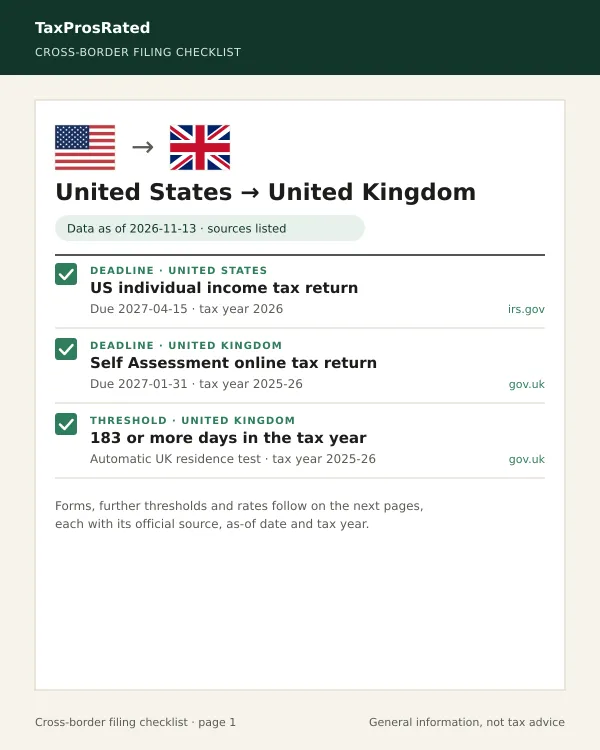
Cross-border filing checklist
- A PDF and a web copy of the checklist for the country pair you choose
- Filing deadlines for both countries, each with the official source URL and as-of date
- The forms named by each tax authority, with a link to the authority's own page
$29 one-time · One payment, no renewal. Tax, if any, is shown at checkout.
More countries in this region · All jurisdictions · Bulgaria filing deadlines · Bulgaria in the tax rates index · Cross-border filing checklist
Change log
- Country summary updated
- Reviewed against National Revenue Agency (Natsionalna Agentsiya za Prihodite — NAP)
Sources
The figures, dates, and rules on this page are sourced from the documents listed below. Where two sources disagree, both are listed.
Important disclaimer
Informational only — not tax advice. This page summarises publicly available information about tax in Bulgaria as of November 2026. Tax laws change, individual circumstances vary, and the application of any rule depends on your specific facts.
TaxProsRated does not provide tax, legal, accounting, or financial advice. Before acting on anything you read here, consult a qualified tax professional licensed in your jurisdiction (in the US: CPA, Enrolled Agent, or attorney; in the UK: CIOT- or ATT-qualified adviser; in Australia: TPB-registered tax agent; elsewhere: a locally-licensed equivalent). TaxProsRated, its operators, and its contributors disclaim all liability for action taken in reliance on this page.