
Country
Tax in Bahamas Sourced summary, not advice.
 Tax in Bahamas Sourced summary, not advice.
Bahamas's Department of Inland Revenue (DIR) administers no personal income tax and no general corporate income tax. The de-facto corporate levy is the Business Licence Fee at 0.5–1.25% of gross turnover. VAT is 10%. National Insurance Board (NIB) contributions cover employment-related levies at ~9.8% combined. Tax in Bahamas is administered by Department of Inland Revenue.
BS notes on this page are the question-and-answer record already researched for BS. Read the cited government page before treating a figure as current, and speak with a qualified professional in BS about a filing.
Does The Bahamas have a capital gains tax?
No. The Bahamas has no capital gains tax of any kind. Gains from the sale of shares, real estate, businesses, crypto assets, or any other capital asset are not subject to Bahamian tax -- for residents or non-residents alike. The country also imposes no personal income tax, no corporate income tax on domestic profits, no inheritance or estate tax, and no wealth tax. The Department of Inland Revenue (DIR) confirms that individuals and companies face no direct tax on income or capital gains at the national level. 1
This puts The Bahamas in the same zero-direct-tax bracket as the Cayman Islands, British Virgin Islands, and Bermuda. However, the absence of domestic CGT does not automatically shelter foreign nationals from their home-country tax obligations on Bahamian-sourced gains -- a point covered below under CRS reporting.
What taxes does apply in The Bahamas?
Although no direct taxes apply to income or capital gains, The Bahamas raises government revenue through indirect and transaction-based taxes.
Sponsored. We may earn a commission if you sign up through these links, at no cost to you. How we earn

Value Added Tax (VAT) was introduced in January 2015. The standard rate is 10 percent on nearly all goods and services sold or consumed domestically. A reduced rate of 5 percent applies to basic foods, select medical supplies (expanded September 2025 to include baby and adult diapers, feminine hygiene products, and additional medications), and certain hygiene products. Businesses with taxable revenue exceeding BSD 100,000 in any 12-month period must register with the DIR. The VAT is administered through the DIR's Online Tax Administration portal. 12
Real property tax is an annual tax levied on all property in The Bahamas. Rates are progressive and differ by ownership classification. For owner-occupied residential property, the first BSD 300,000 of assessed value is fully exempt; the band from BSD 300,001 to BSD 500,000 is taxed at 0.625 percent per year; value above BSD 500,000 is taxed at 1 percent per year, subject to a BSD 120,000 annual cap. Commercial property rates start at 0.75 percent on the first BSD 500,000, rising to 1 percent on the BSD 500,001 to BSD 2,000,000 band, and 1.5 percent above BSD 2,000,000. Non-Bahamian-owned property is assessed at 1 percent on improvements plus a separate rate on the unimproved land value. [^3]
Conveyance VAT (formerly Stamp Duty) applies to real-estate transfers. Since 1 July 2023 the conveyance charge has been structured as a flat 10 percent VAT on the transaction value, replacing the prior progressive Stamp Duty schedule. By custom the charge is split 50/50 between buyer and seller, though contract terms may vary. Parties must now obtain a VAT invoice from DIR before executing a conveyance -- a procedural change introduced by the July 2025 legislative amendments. 23

Business Licence Fee applies to every person or entity conducting business in The Bahamas, under the Business Licence Act 2010 (as amended). The fee is calculated on the preceding year's gross turnover: BSD 100 flat for turnover up to BSD 50,000; 0.50 percent for turnover from BSD 50,001 to BSD 500,000; 0.75 percent from BSD 500,001 to BSD 5,000,000; and 1.25 percent for turnover above BSD 5,000,000. Licences expire 31 December annually, with a grace period to 31 January. Late payment incurs a 10 percent surcharge and 5 percent annual interest after 30 days. [^5]
Customs duty applies to imported goods, calculated on cost-insurance-freight (CIF) value using tariff headings from the Customs Management Act. Rates range from 0 percent to 220 percent depending on product category, with most consumer goods falling in the 5 to 35 percent band. A 1 percent customs processing fee applies (minimum BSD 10, maximum BSD 750). Revised tariff schedules took effect July 2025 targeting reductions on energy-efficient goods and building materials. [^6]
National Insurance Contributions (NIC) are paid by employers (6.65 percent) and employees (4.65 percent) on weekly earnings up to BSD 810. Self-employed individuals contribute 10.3 percent on the same ceiling. NICs fund the National Insurance Board's pension and social-security programmes and are not income taxes. 1
Summary table: tax types in The Bahamas
| Tax type | Levied in Bahamas? | Notes |
|---|---|---|
| Capital gains tax | No | No statute; gains on all asset types untaxed |
| Personal income tax | No | No personal income or payroll tax |
| Corporate income tax | No | No general CIT on domestic profits |
| Inheritance / estate tax | No | No estate or gift tax |
| VAT | Yes -- 10% standard | 5% reduced rate on select essentials |
| Real property tax | Yes -- progressive | Annual; owner-occupied exempt up to BSD 300k |
| Conveyance VAT | Yes -- 10% flat | On real-estate transfers; split buyer/seller |
| Business Licence Fee | Yes -- turnover-based | 0.50% to 1.25%; flat BSD 100 for micro-turnover |
| Customs duty | Yes -- 0% to 220% | CIF-based; most consumer goods 5%-35% |
| National Insurance | Yes -- 4.65%/6.65% | Employee/employer; social-security only |
| MNE Domestic Top-Up Tax | Yes -- 15% floor | In-scope MNE groups only; enacted Nov 2024 |
What is the 15% Domestic Minimum Top-Up Tax for multinational groups?
The Bahamas enacted the Domestic Minimum Top-Up Tax Act (DMTT Act) on 29 November 2024, implementing the OECD/G20 Pillar Two global minimum tax framework. The DMTT is deemed retroactively effective from 1 January 2024 for fiscal years starting after 31 December 2023.
The DMTT applies only to in-scope multinational enterprise (MNE) groups -- those with consolidated global revenues of EUR 750 million or more in at least two of the four fiscal years preceding the year under review. Businesses that operate solely within The Bahamas are expressly excluded regardless of their local revenue. The top-up mechanism works as follows: if an in-scope MNE group's Bahamian constituent entities pay an effective tax rate below 15 percent on Bahamian profits, the DMTT collects the difference up to the 15 percent floor. Qualifying Domestic Minimum Top-Up Tax (QDMTT) safe-harbour provisions allow the top-up taxes otherwise collectible by other jurisdictions to be treated as zero when the Bahamas DMTT applies. Returns must be filed within 15 months after the last day of each fiscal year (18 months for the transition year). The Business Licence (Amendment) Act 2025, effective 1 January 2024, introduced tax credits so that DMTT liability can offset applicable Business Licence fee obligations. [^7][^8]
For operators of standard domestic or small-group businesses, the DMTT is irrelevant -- the EUR 750 million threshold is far above typical commercial activity in The Bahamas.
Do Bahamas residents need to report foreign gains elsewhere?
The Bahamas participates in the OECD Common Reporting Standard (CRS), meaning Bahamian financial institutions automatically exchange account information with the tax authorities of participating CRS partner countries. A Bahamian-resident national of a CRS-partner country who holds foreign assets through Bahamian accounts may therefore have that information reported to their home country's tax authority.
US citizens are separately subject to FATCA (Foreign Account Tax Compliance Act) and to US federal income tax on worldwide income regardless of residence -- US citizens in The Bahamas remain liable for US capital gains tax on gains wherever realised. The Bahamas has no bilateral tax treaty with the United States, but has signed Tax Information Exchange Agreements (TIEAs) with the US, UK, Canada, and other partners. 1
Anyone managing cross-border asset positions should consult a qualified tax professional familiar with both Bahamian and home-country rules before relying on the zero-CGT status of The Bahamas as a complete shelter.
For a broader picture of living, working, or investing in The Bahamas, see the The Bahamas country overview. Because individual circumstances vary significantly -- especially for expatriates, foreign investors, or members of large corporate groups -- the information on this page is a neutral factual summary only. Always confirm current rules and how they apply to your situation with a qualified tax professional.
Capital Gains Tax in The Bahamas: No CGT, VAT, Property Tax, and the 2024 MNE Top-Up
The Bahamas levies no capital gains tax, no income tax, and no inheritance tax. Taxes that do apply are VAT at 10%, annual real property tax (progressive by assessed value), a conveyance VAT charge on real-estate transfers, a turnover-based business licence fee, and -- for large multinational groups -- a 15% domestic minimum top-up tax enacted in November 2024.
Does The Bahamas impose any capital gains tax?
No. The Bahamas has no capital gains tax statute. Gains from the disposal of shares, real estate, businesses, crypto assets, or any other capital asset are not subject to Bahamian tax for residents or non-residents. The country also imposes no personal income tax, no corporate income tax on domestic profits, no inheritance tax, and no wealth tax, confirmed by the Department of Inland Revenue.
What is the VAT rate in The Bahamas?
The standard VAT rate is 10 percent on nearly all goods and services consumed in The Bahamas. A reduced rate of 5 percent applies to basic foods, select medical supplies, baby and adult diapers, and feminine hygiene products -- the reduced-rate list was expanded effective September 2025. Businesses with taxable turnover exceeding BSD 100,000 in any 12-month period are required to register with the Department of Inland Revenue.
How does real property tax work in The Bahamas?
Real property tax is an annual tax on assessed value. Owner-occupied residential property is fully exempt up to BSD 300,000; the BSD 300,001 to BSD 500,000 band is taxed at 0.625 percent; above BSD 500,000 at 1 percent (capped at BSD 120,000 per year). Commercial property rates range from 0.75 percent to 1.5 percent. Foreign-owned property is assessed at 1 percent on improvements plus a rate on unimproved land value.
Is there a tax on selling real estate in The Bahamas?
No capital gains tax applies to real-estate sales. However, a 10 percent conveyance VAT is charged on the transaction value of the transfer. This replaced the prior progressive Stamp Duty schedule from 1 July 2023. By custom the charge is split equally between buyer and seller, though contract terms may differ. Parties must obtain a VAT invoice from the Department of Inland Revenue before executing the conveyance.
What is the Domestic Minimum Top-Up Tax and who does it affect?
The DMTT Act, enacted 29 November 2024 and effective from 1 January 2024, implements the OECD Pillar Two global minimum tax. It applies only to multinational enterprise groups with consolidated global revenues of EUR 750 million or more in at least two of the four preceding fiscal years. The 15 percent floor tops up any shortfall below that rate on Bahamian profits. Purely domestic businesses and most SMEs are entirely outside its scope.
Does the Bahamas tax individual cryptocurrency gains?
No. The Bahamas imposes no personal income tax, no capital gains tax, and no wealth tax on individuals. The Department of Inland Revenue confirms that government revenue comes primarily from Value Added Tax (VAT), import duties, business licence fees, and real property tax -- not from taxing personal income or investment gains.
Because there is no capital gains regime, a Bahamian tax resident who buys and later sells Bitcoin, Ethereum, or any other digital asset owes no Bahamian tax on any profit from that sale. The same applies to staking rewards, airdrops, and mining proceeds received by individuals: none of these trigger a personal tax liability under Bahamian law (Department of Inland Revenue, inlandrevenue.finance.gov.bs).
What does the DARE Act 2024 require for crypto businesses?
The Digital Assets and Registered Exchanges Act 2024 (DARE Act 2024), enacted by Parliament on 29 July 2024, is the primary regulatory framework for digital-asset businesses operating in or from the Bahamas. It replaces and substantially expands the original DARE Act 2020. The Securities Commission of the Bahamas (SCB) administers the law.
What taxes apply to crypto businesses in the Bahamas?
Businesses -- including digital-asset businesses -- are subject to Business Licence Tax administered by the Department of Inland Revenue. The rate is 2.5 percent of gross turnover generated from Bahamian domestic operations, with a minimum of BSD 2,500 annually. Turnover from operations outside the domestic market is assessed at the greater of BSD 2,500 or 0.25 percent of that turnover, subject to a BSD 100,000 cap (Business Licence Act 2023).
How does the CARF commitment affect Bahamian crypto holders?
The Bahamas signed the OECD Crypto-Asset Reporting Framework Multilateral Competent Authority Agreement (CARF-MCAA) on 19 November 2024. Under this commitment, Bahamian-licensed crypto-asset service providers will be required to collect and report user transaction data to the Bahamas Department of Inland Revenue beginning with the 2026 reporting year. The Bahamas is among the jurisdictions targeting first exchanges with partner jurisdictions by 2027-2028 (OECD, oecd.org/tax/automatic-exchange).
Cryptocurrency Taxation in the Bahamas: No Personal Income Tax, No Capital Gains Tax, and the DARE Act 2024
Individual crypto gains in the Bahamas are generally not taxed. The Bahamas levies no personal income tax, no capital gains tax, and no inheritance tax. Crypto businesses operating from the Bahamas must register under the Digital Assets and Registered Exchanges Act 2024 (DARE Act) and may owe Business Licence Tax and VAT on services.
Does the Bahamas tax individuals on cryptocurrency profits?
No. The Bahamas imposes no personal income tax and no capital gains tax. An individual tax resident who sells Bitcoin or any other digital asset at a profit owes no Bahamian tax on that gain, regardless of the amount or holding period. The same applies to staking rewards, mining proceeds, and airdrops received by individuals. The Department of Inland Revenue confirms this through the absence of any direct personal tax statutes.
What is the DARE Act 2024 and who must register?
The Digital Assets and Registered Exchanges Act 2024 (DARE Act 2024), effective 29 July 2024, requires any company providing digital-asset services in or from the Bahamas to register with the Securities Commission of the Bahamas (SCB).
Covered activities include exchanges, custody, staking, brokerage, advisory, and token issuance. Mining as a standalone commercial activity is prohibited; privacy tokens and algorithmic stablecoins may not be offered.
What taxes does a crypto business owe in the Bahamas?
A registered digital-asset business pays Business Licence Tax of 2.5 percent of domestic gross turnover (minimum BSD 2,500 annually) and VAT at 10 percent on fee-bearing services such as brokerage or custody fees. There is no corporate income tax.
The exchange of cryptocurrency itself is generally not treated as a VAT-able supply; only service fees trigger VAT. Businesses must also maintain AML/CFT compliance as financial institutions under the Financial Transactions Reporting Act 2018.
What is the VAT rate in the Bahamas and does it apply to buying or selling crypto?
The standard VAT rate in the Bahamas is 10 percent. Buying or selling cryptocurrency is generally not subject to VAT because the Bahamas treats crypto as a payment method rather than a taxable good or service. VAT does apply to goods and services purchased using crypto -- the underlying transaction is taxed at 10 percent as usual. Fee-bearing crypto business services are VAT-able once the provider meets the registration threshold.
How does the Bahamas CARF commitment affect crypto reporting?
The Bahamas signed the OECD Crypto-Asset Reporting Framework MCAA on 19 November 2024. Bahamian-licensed crypto platforms must begin collecting standardised transaction and identity data for the 2026 reporting year, with first automatic exchanges to partner jurisdictions expected in 2027-2028.
This creates no new Bahamian tax liability -- the Bahamas still imposes no income or gains tax -- but it increases cross-border information sharing with jurisdictions that do tax crypto.
Are dividends and investment income taxed in The Bahamas?
The Bahamas imposes no personal income tax, no dividend tax, no interest tax, and no capital gains tax. The Government of The Bahamas confirms that capital gains, personal income, corporate earnings, and dividends are all exempt from taxation under Bahamian law. [1] Individuals receiving dividends from Bahamian-incorporated companies owe nothing to the Bahamian tax authority, whether they are residents or non-residents. Interest earned on bank deposits, government securities, or corporate bonds is similarly untaxed. This zero-tax-on-investment-income position is consistent across all asset classes for individual investors.
One narrow exception involves stamp duty: when a company converts BSD 500,000 or more into foreign currency and remits those funds abroad as dividends to a related party, a 5% stamp duty applies to the converted amount. [2] This is a corporate-level currency-conversion charge, not a personal withholding tax, and it does not affect most individual shareholders.
More on Bahamas
The rest of the Bahamas reference is on the Bahamas tax guide, in 3 parts: part 1, part 2, part 3.
- Does The Bahamas impose withholding tax on dividends or interest paid to non-residents?
- What is the new 15% Domestic Minimum Top-Up Tax (DMTT) and does it affect investors?
- Why do investment funds and private-wealth structures favor The Bahamas?
- Do CRS and FATCA reporting obligations still apply despite the zero-tax environment?
- What tax obligations do investors face in their home country?
- Dividend and Investment Tax in The Bahamas: No Income Tax, No Withholding, and the New DMTT Explained
- Are dividends from Bahamian companies subject to any tax in The Bahamas?
- Is interest income taxed in The Bahamas?
- Who does the new 15% Domestic Minimum Top-Up Tax affect?
- Does CRS or FATCA reporting apply to Bahamian investment accounts?
- Must an investor pay tax on Bahamian investment income in their home country?
- Does living in The Bahamas create an income-tax liability?
- How do you become a resident of The Bahamas?
- What is the Bahamas tax-residency certificate and who needs one?
- What taxes do exist in The Bahamas?
- Does Bahamian residency eliminate your home-country tax obligation?
- Expat Tax Residency in The Bahamas: No Income Tax, Permanent Residency by Investment, and the CRS Certificate
- Does The Bahamas tax your income if you become a resident?
- What is the minimum investment to get permanent residency in The Bahamas?
- How do I get a Bahamas tax-residency certificate for CRS purposes?
- Do US citizens still owe US tax after moving to The Bahamas?
- Is the Bahamas BEATS digital-nomad permit still available?
- Does The Bahamas have an inheritance or estate tax?
- What does happen when someone dies in The Bahamas?
- How does probate work for foreign-held assets?
- Why is The Bahamas used for succession planning?
- What taxes do cross-border heirs still face?
- Territorial nature of Bahamian tax
- Inheritance and Estate Tax in The Bahamas
- Does The Bahamas charge any tax on inherited money or property?
- Is real property in a Bahamian estate subject to VAT when it passes to heirs?
- How long does probate take in The Bahamas and what does it cost?
- Do US citizens living in The Bahamas still owe US estate tax?
- Why do high-net-worth families use Bahamian trusts for succession planning?
- What are the current Real Property Tax rates for residential properties in The Bahamas?
- How are commercial and investment properties taxed annually?
- What is the conveyance VAT on property transfers, and how does it differ for Bahamians and non-Bahamians?
- Does The Bahamas impose capital gains tax or income tax on real estate?
- What rules govern property ownership by non-Bahamians under the International Persons Landholding Act?
- Bahamas Property Tax Overview: Real Property Tax Rates, Conveyance VAT, and Non-Resident Rules
- Is an owner-occupied home in The Bahamas exempt from Real Property Tax?
- What is the conveyance VAT rate when a non-Bahamian buys property in The Bahamas?
- Does The Bahamas charge capital gains tax when real estate is sold?
- When does a non-Bahamian need a permit rather than a registration certificate under the International Persons Landholding Act?
- Is there a discount for paying Bahamas Real Property Tax early?
- Do self-employed people pay income tax in The Bahamas?
- What is the Business Licence fee and who must pay it?
- How do NIB contributions work for self-employed people?
- When does VAT registration become compulsory?
- What are the steps to register as a self-employed person?
- What about Bahamian residents who work for foreign clients?
- Self-Employed Tax in The Bahamas: No Income Tax, Business Licence, NIB, and VAT Explained
- Do self-employed people in The Bahamas pay income tax on their profits?
- What is the NIB contribution rate for self-employed people in The Bahamas in 2026?
- When does a self-employed person in The Bahamas have to register for VAT?
- How much does a Business Licence cost for a small self-employed person in The Bahamas?
- Does a Bahamian freelancer working for foreign clients owe tax in The Bahamas on that income?
- Do small businesses pay income tax in The Bahamas?
- What is the Business Licence fee, and who pays it?
- When must a small business register for VAT?
- What payroll contributions apply to employers?
- Does real property tax apply to business premises?
- What does the new 15% domestic minimum top-up tax mean for small businesses?
- How does a small business register and stay compliant?
- Small-Business Tax in The Bahamas: No Income Tax, Business Licence Fees, VAT, and NIB
- Does The Bahamas have corporate income tax?
- What is the Business Licence fee for a small business in The Bahamas?
- At what level must a Bahamian small business register for VAT?
- What NIB contributions does a Bahamian employer pay?
- Does the new 15% Pillar Two tax affect ordinary Bahamian small businesses?
- Does The Bahamas have double-tax treaties?
- What does The Bahamas have instead of DTAs? The TIEA network
- What CRS, FATCA, and CARF obligations apply?
- How does foreign withholding tax affect Bahamian residents with no treaty relief?
- What is the Domestic Minimum Top-Up Tax (DMTT) and who is affected?
- What is The Bahamas' OECD and EU listing status?
- Tax Treaty Relief in The Bahamas: Why No DTAs Exist, TIEAs, CRS/FATCA, CARF, and the New DMTT
- Does The Bahamas have any double-tax treaties?
- How many TIEAs has The Bahamas signed and with which countries?
- Is a US citizen living in The Bahamas protected from US tax by a treaty?
- What is the new 15% DMTT and does it affect individuals?
- How does CRS automatic exchange of information affect accounts held in The Bahamas?
- What is the current standard VAT rate in The Bahamas?
- Which supplies are zero-rated or carry the reduced 5% rate?
- What supplies are exempt from VAT entirely?
- What is the registration threshold and how does a business register?
- How does VAT on real-estate conveyances work?
- Summary of Bahamian VAT rates by supply type (2026)
- Filing obligations: quarterly and monthly returns
- VAT and Sales Tax in The Bahamas (2026): Rates, Registration, Reduced Categories, and Real-Estate Conveyance
- What is the current standard VAT rate in The Bahamas?
- Which goods are now zero-rated or exempt from Bahamas VAT?
- What is the VAT registration threshold in The Bahamas?
- How does VAT apply to real-estate conveyances in The Bahamas?
- How often must a VAT-registered business in The Bahamas file returns?
- Does the Bahamas have a sales tax?
Frequently asked
Who is the Bahamian tax authority?
Department of Inland Revenue (DIR), under the Ministry of Finance. DIR administers VAT, Business Licence Fees, and the new Pillar Two QDMTT levy under the Domestic Minimum Top-up Tax Act 2024.
When is the Bahamian annual return due?
No personal income tax returns. Business Licence annual returns due 31 January. VAT monthly returns due 21st of the following month. Pillar Two QDMTT returns due 6 months after fiscal year-end for in-scope MNEs. NIB contributions monthly.
Who is a Bahamian tax resident?
Tax residency is relevant primarily for NIB contribution liability and for issuance of tax residency certificates for treaty purposes. There is no income-tax residency concept because there is no personal income tax. DIR issues certificates based on physical presence and economic-substance criteria.
What are the Bahamian personal income tax rates?
None — Bahamas levies no personal income tax on wages, dividends, interest, capital gains, or inheritance. National Insurance Board (NIB) contributions are 3.9% (employee) plus 5.9% (employer) on wages up to a statutory ceiling.
How does the Bahamas corporate tax framework work?
No general corporate income tax. The de-facto levy is the Business Licence Fee at approximately 0.5–1.25% of gross annual turnover, tiered by revenue band, due 31 January. Pillar Two QDMTT at 15% applies under the Domestic Minimum Top-up Tax Act 2024 from 2025 for MNE groups with consolidated revenue at or above EUR 750 million.
What is the Bahamian VAT rate?
VAT is 10% standard rate under the VAT Act 2014 (reduced from 12% in January 2022; originally 7.5% from 2015). Exports are zero-rated. Financial services and residential rent are exempt. Monthly e-Filing is mandatory.
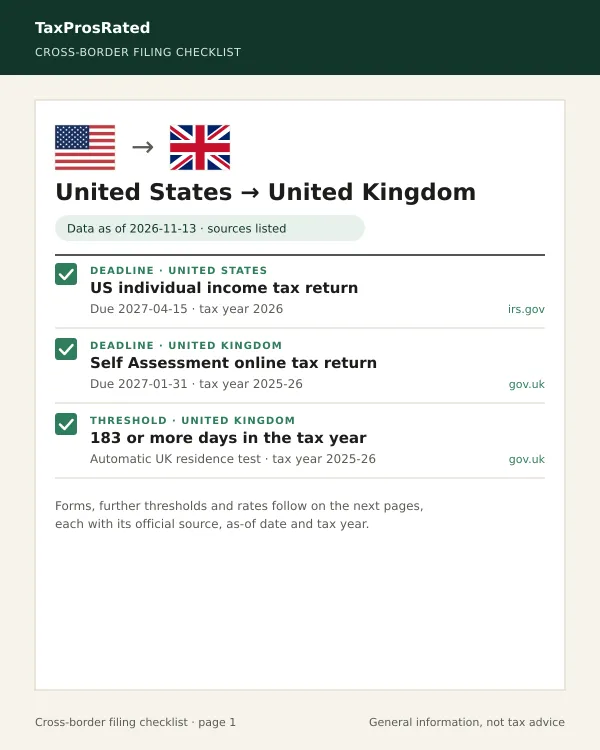
From TaxProsRated · our own product
Cross-border filing checklist
- A PDF and a web copy of the checklist for the country pair you choose
- Filing deadlines for both countries, each with the official source URL and as-of date
- The forms named by each tax authority, with a link to the authority's own page
$29 one-time · One payment, no renewal. Tax, if any, is shown at checkout.
More countries in this region · All jurisdictions · Bahamas filing deadlines · Bahamas in the tax rates index · Cross-border filing checklist
Change log
- Country summary updated
- Rate source updated: inheritance
- Rate source updated: capital-gains
- Rate source updated: vat
- Rate source updated: personal-income
- Rate source updated: corporate-income
- Country summary updated
- Reviewed against Department of Inland Revenue
Sources
The figures, dates, and rules on this page are sourced from the documents listed below. Where two sources disagree, both are listed.
Important disclaimer
Informational only — not tax advice. This page summarises publicly available information about tax in Bahamas as of November 2026. Tax laws change, individual circumstances vary, and the application of any rule depends on your specific facts.
TaxProsRated does not provide tax, legal, accounting, or financial advice. Before acting on anything you read here, consult a qualified tax professional licensed in your jurisdiction (in the US: CPA, Enrolled Agent, or attorney; in the UK: CIOT- or ATT-qualified adviser; in Australia: TPB-registered tax agent; elsewhere: a locally-licensed equivalent). TaxProsRated, its operators, and its contributors disclaim all liability for action taken in reliance on this page.