
Country
Tax in Ecuador Sourced summary, not advice.
 Tax in Ecuador Sourced summary, not advice.
Ecuador's Servicio de Rentas Internas (SRI) administers personal income tax at progressive 0–37% across ten brackets, corporate income tax at 25% (22% reduced for SMEs under the RIMPE regime), and IVA at 15% (raised from 12% on 1 April 2024). Tax in Ecuador is administered by Servicio de Rentas Internas (SRI).
Arriving in Cuenca with a toolbox and an Ecuador question
A cabinetmaker who landed at Mariscal Lamar with a crate of hand tools and a sublet in El Centro is not an Ecuador taxpayer merely because the aircraft doors opened. Ecuador uses the United States dollar as everyday money, so the first papers from a Cuenca landlord, a ferretería on Calle Larga, and a bus down toward Guayaquil are already written in that currency. Ecuador still expects a person who sells labour on its territory to be known to the Servicio de Rentas Internas before invoices begin to circulate. The practical question is which counter opens an Ecuador file, which indirect charges appear on a local purchase, and which papers belong in a folder if a workshop at the edge of Cuenca starts to take paid work. TaxProsRated can name the office and sketch the character of the Ecuador system. TaxProsRated does not open that file, compute an amount, or speak for the cabinetmaker before any authority.
The same landing looks different if the cabinetmaker is only visiting a cousin in Cuenca and will leave before any paid job starts. Ecuador distinguishes presence as a guest from presence that produces receipts. That distinction is not drawn in an essay like this one. It is drawn from facts the Servicio de Rentas Internas asks about, read against the materials published for Ecuador on the SRI site. Until that reading happens, the sound Ecuador habit is to keep every dollar receipt, every lease, and every message that offers paid work, and to treat neighbourhood talk about what "everyone in Cuenca pays" as rumour.
Servicio de Rentas Internas as the Ecuador office that opens the file
Servicio de Rentas Internas, shortened in daily speech to SRI, is the Ecuador office that registers taxpayers and administers internal revenue. The public site of that office is the citation attached to this Ecuador note. A cabinetmaker who will bill clients in Cuenca, Quito, or Guayaquil should expect the SRI conversation to start with identity, address, and a description of the activity, rather than with a story carried across a border. Ecuador issues a taxpayer identity, widely called the RUC, once registration is accepted. That identity is how an Ecuador customer, a bank, and the SRI recognise the same person. No Ecuador form is reproduced here, and a screenshot from an earlier season is not assumed to still be the right sheet.
SRI counters and electronic channels exist so an Ecuador revenue file can be opened without guessing that a municipal desk handles national internal revenue. A Cuenca municipality may license a workshop, and a parish may care about noise and rubbish, yet those local steps do not replace the Ecuador revenue file. Current SRI instructions on the cited site should be read before any third-party checklist is treated as complete. If the activity is employment by an Ecuador firm rather than self-directed work, the employing firm usually carries the payroll-side duties, while the person still keeps identity papers that match the Ecuador file.
How indirect tax and the customs border behave in Ecuador
Ecuador indirect tax appears in ordinary shopping long before any annual reckoning. A value-added style charge, known locally as IVA, belongs to the price conversation in a Cuenca hardware shop and in a Quito hotel bill. Ecuador also places excise-style charges on selected goods, so a receipt for a vehicle or a bottled drink can carry a different indirect character from a receipt for timber. No percentage is copied into this essay. The SRI publication is where an Ecuador rate belongs, and rates are revised. Freezing a figure on a reference page would invite the cabinetmaker to trust a number after it had moved.
Sponsored. We may earn a commission if you sign up through these links, at no cost to you. How we earn

Goods that cross the Ecuador frontier meet customs treatment that is a different conversation from IVA on a domestic sale. A crate of blades arriving through Guayaquil, or a courier parcel addressed to Cuenca, can attract border formalities even after an RUC already exists. Dollarized tills do not erase the Ecuador border. Andean workshops, coastal ports, and travel onward to the Galápagos sit inside one republic, yet a shipment follows the border rules of the competent Ecuador authority rather than a blog summary. No Ecuador tariff schedule is invented on this page.
Direct charge on Ecuador income, described without any figure
Ecuador direct tax reaches personal receipts and business profits in categories the SRI describes, including income of a person, profits of a company, and payments from which another person may already have withheld. Withholding is a familiar Ecuador mechanism. A client in Cuenca may retain part of a professional payment and send it onward, which means the cabinetmaker's own Ecuador reckoning must recognise amounts already transmitted. The retained part is not stated here. Stating it would turn a note like this one into a calculator, and the retained part is precisely the sort of figure that has to be read on the SRI site for the relevant period.
Residence, source, and the kind of activity all matter in Ecuador, and they do not collapse into a slogan. A person who keeps a home in Cuenca, invoices only foreign clients, and is paid into a dollar account still has an Ecuador question, because the place of the work and the place of the client can point different ways. SRI texts are the place to resolve that direction. Ecuador companies face their own profit reckoning, separate from the personal file of a shareholder who also swings a hammer. No structure is ranked here. Any structure has to be one the SRI can see in the Ecuador file.
Wage slips and invoices a contractor should keep in Ecuador
Employment in Ecuador brings a second stack of papers beside the revenue file. A workshop that hires a helper owes wage records, identity copies, and the social-security relationship running through the Instituto Ecuatoriano de Seguridad Social. That institute is not the SRI, and a payment toward one does not silently satisfy the other. The cabinetmaker who remains self-directed still needs invoices showing the RUC, the client, the date, and a description of the Cuenca job. Dollar bank statements help reconstruct a month when a paper invoice disappears. Ecuador electronic invoicing has become ordinary for many activities, so a handwritten scrap may not be the record the SRI expects. The current SRI description of electronic invoicing controls, rather than a habit imported from abroad.
The Ecuador folder should stay dull and complete: the lease, any entry or residence card that exists, the RUC certificate, invoices issued, invoices received, withholding certificates handed over by clients, and any payroll slip if an Ecuador employer appears later. None of those documents is produced by TaxProsRated. A practitioner can help assemble them only under a separate engagement that sits outside this essay. Until that engagement exists, the folder remains the cabinetmaker's own charge.
Where this Ecuador page stops
This Ecuador entry can point to the Servicio de Rentas Internas and can describe, in plain words, the kind of charges a newcomer meets. It cannot know whether the Cuenca sublet creates residence, whether selling a finished cabinet is an occasional act or an ongoing activity, or whether another country also asks about the same dollars. Those are facts and legal characterisations that belong in the SRI materials and, if the cabinetmaker so chooses, in a conversation with a qualified Ecuador professional engaged for that work. TaxProsRated lists professionals. It does not file, withhold, or appear for anyone at the SRI.
Anyone who offers a single Ecuador figure in a chat group, detached from the SRI page, is offering a number this essay will not launder into prose. Read the cited SRI site, match the Cuenca activity to the instructions published there, and treat these paragraphs as orientation for a person who arrived with tools, not as a finished Ecuador position.
Frequently asked
Who is the Ecuadorian tax authority?
Servicio de Rentas Internas (SRI), under the Ministerio de Economia y Finanzas, administers Ecuador's tax system. Servicio Nacional de Aduana del Ecuador (SENAE) handles customs and import IVA. Filings go through SRI Online at sri.gob.ec. The credentialed tax profession is the Contador Publico Autorizado (CPA), regulated by FNCE.
When is the Ecuadorian annual return due?
Personal income tax returns are due in March of the following year on a staggered schedule by ninth digit of the RUC (10-28 March). Corporate returns (Form 101 PDT) are due in April on the same staggered schedule. Monthly IVA (Form 104) and withholdings (Form 103) are due 10-28 of the following month. Corporate advance payments (Anticipo) are due in July and September.
Who is an Ecuadorian tax resident?
Tax residents are physically present in Ecuador for more than 183 days in any 12-month period, OR present 183 days or more in the calendar year with more than 50% of assets and economic interests in Ecuador. Residents pay tax on worldwide income. Non-residents pay tax on Ecuadorian-source income only, generally at 25% flat withholding.
What are the Ecuadorian personal income tax rates?
Ten progressive brackets in USD for 2024: 0% up to USD 11,902; then 5%, 10%, 12%, 15%, 20%, 25%, 30%, 35%, and 37% across bands ending at over USD 107,500. Standard personal deduction USD 5,000. Employee-side IESS social security adds 9.45%. ISD at 5% applies on outbound foreign-currency transfers.
How does Ecuador's corporate tax work?
Corporate income tax is 25% on profit. SMEs and micro-enterprises under USD 300,000 annual revenue may elect the RIMPE regime (0-3% on gross revenue). Withholding on dividends to non-residents is 25% (treaty rates apply). Loss carryforward runs 5 years; carryback is unavailable. Pillar Two has not yet been transposed. ISD at 5% stacks on outbound cross-border payments.
What is the Ecuadorian IVA rate?
IVA was raised from 12% to 15% on 1 April 2024 under the Ley Organica para Enfrentar el Conflicto Armado Interno following the January 2024 declaration of internal armed conflict. Zero-rated supplies include medicine, basic foodstuffs, and exports. Foreign digital services face IVA via reverse-charge since 2020. Comprobantes electronicos are broadly mandatory.
From TaxProsRated · our own product
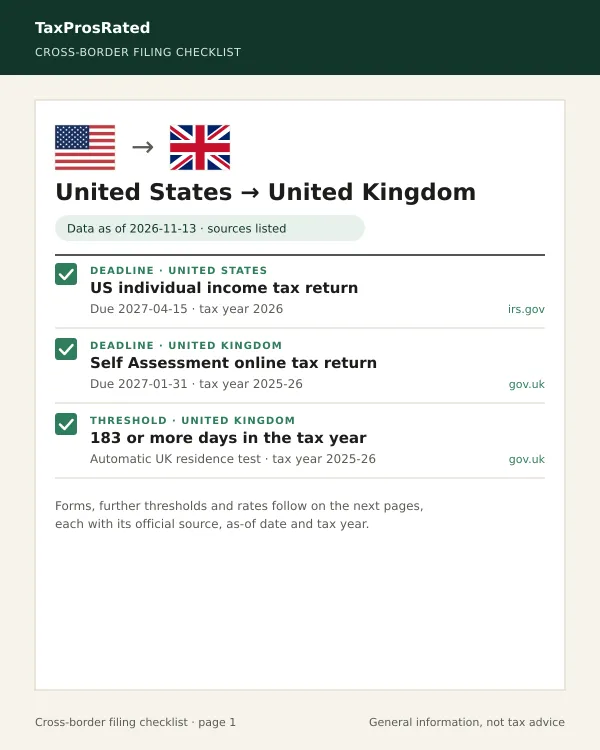
Cross-border filing checklist
- A PDF and a web copy of the checklist for the country pair you choose
- Filing deadlines for both countries, each with the official source URL and as-of date
- The forms named by each tax authority, with a link to the authority's own page
$29 one-time · One payment, no renewal. Tax, if any, is shown at checkout.
More countries in this region · All jurisdictions · Ecuador filing deadlines · Ecuador in the tax rates index · Cross-border filing checklist
Change log
- Country summary updated
- Country summary updated
- Reviewed against Servicio de Rentas Internas (SRI)
Sources
The figures, dates, and rules on this page are sourced from the documents listed below. Where two sources disagree, both are listed.
Important disclaimer
Informational only — not tax advice. This page summarises publicly available information about tax in Ecuador as of November 2026. Tax laws change, individual circumstances vary, and the application of any rule depends on your specific facts.
TaxProsRated does not provide tax, legal, accounting, or financial advice. Before acting on anything you read here, consult a qualified tax professional licensed in your jurisdiction (in the US: CPA, Enrolled Agent, or attorney; in the UK: CIOT- or ATT-qualified adviser; in Australia: TPB-registered tax agent; elsewhere: a locally-licensed equivalent). TaxProsRated, its operators, and its contributors disclaim all liability for action taken in reliance on this page.