
Country
Tax in Panama Sourced summary, not advice.
 Tax in Panama Sourced summary, not advice.
Tax in Panama is administered by Dirección General de Ingresos (DGI Panamá). This page gives the headline tax rates on record for Panama, the next filing deadline and the main rules. Each figure carries its date and its official source, or is marked source pending.
Tax rates
Corporate income tax
General rate for legal entities (table: fiscal periods / rate); 30% for companies with over 40% State shareholding
Top personal income tax
Individuals (personas naturales), net taxable income above B/.50,000.00; page states no year
Lowest personal income tax
Lowest non-zero band; up to B/.11,000.00 taxed at 0%; page states no year
VAT / GST (standard)
ITBMS general rate since 1 July 2010; higher rates for alcohol, lodging and tobacco
Rate table
CSV| Tax | Rate | As of | Source |
|---|---|---|---|
| Corporate income tax | 25General rate for legal entities | Dirección General de Ingresos | |
| Top personal income tax | 25Individuals, net taxable income above B/.50,000.00 | Dirección General de Ingresos | |
| Lowest personal income tax | 15Lowest non-zero band | Dirección General de Ingresos | |
| VAT / GST (standard) | 7ITBMS general rate since 1 July 2010 | Dirección General de Ingresos |
Who is the tax authority?
The Direccion General de Ingresos (DGI) administers Panama's ISR, ITBMS, stamp duties, and all national taxes under the Ministerio de Economia y Finanzas (MEF). The Autoridad Nacional de Aduanas (ANA) handles import duties and customs. Large taxpayers fall under the Departamento de Grandes Contribuyentes within DGI.
Filing runs through e-Tax 2.0, Panama's main online portal for declarations and payments. The e-Factura electronic-invoicing regime has been progressively rolled out since 2018, with an expansion phase completed in 2024. The principal credentialed accounting profession is the Contador Publico Autorizado (CPA), regulated by the Junta Tecnica de Contabilidad.
Sponsored. We may earn a commission if you sign up through these links, at no cost to you. How we earn

Tax disputes proceed: DGI recurso de reconsideracion → Tribunal Administrativo Tributario (TAT) → Sala Tercera of the Corte Suprema de Justicia → constitutional review.
Tax year and filing deadlines
Panama uses the calendar year (1 January to 31 December) as the standard tax year for both individuals and corporations. Key statutory deadlines are fixed annually in the Codigo Fiscal.

Wage earners fully withheld through monthly payroll deductions generally have no year-end balance due. Self-employed individuals with diverse income sources and corporations must file independently. The Aviso de Operacion annual operating fee is a separate quasi-tax obligation billed by company classification, distinct from ISR.
Residency and the territorial principle
A person becomes a Panamanian tax resident under any of three tests: physically present in Panama for 183+ days in any 12-month period ending in the tax year; maintaining permanent domicile in Panama; or having the centre of vital interests in Panama.
Personal income tax
Panama levies PIT on Panama-source income only, across three brackets. Social security and education levies stack on top of ISR.
| Category | Rate |
|---|---|
| PIT Band 1 | 0% — USD 0 to 11,000 |
| PIT Band 2 | 15% — USD 11,001 to 50,000 |
| PIT Band 3 | 25% — USD 50,001+ |
| CSS employee | 9.75% |
| CSS employer | 12.25% |
| Seguro Educativo employee | 1.25% |
| Seguro Educativo employer | 1.5% |
| Capital gains | 10% flat (5% PSE-quoted) |
| Panama-source dividends WHT | 10% (5% PSE-quoted) |
| Non-resident WHT on PA-source | 25% flat |
The USD-denominated thresholds are fixed in the Codigo Fiscal and do not index annually. Panama's dollarized economy eliminates exchange-rate translation complexity for USD-earning residents.
Corporate income tax
Panama's ISR for corporations is 25% on Panama-source taxable income. The CAIR (Calculo Alterno de Impuesto sobre la Renta) applies a minimum-tax floor to businesses with gross revenue exceeding PAB 1.5 million.
Net Panama-source taxable income. Applies to most domestic and foreign-owned companies with Panama operations. 5-year loss carryforward, 20% annual offset cap. No carryback.
Applied to gross revenue when that produces higher ISR than 25% of net income. Catches low-margin and loss-making businesses above PAB 1.5M gross revenue — a structural trap for high-turnover, thin-margin sectors.
ISR for licensed, substance-meeting entities in Zonas Libres. Substance requirements progressively tightened post-BEPS. Annual documentation of Panama-based operations now essential.
Sede de Empresas Multinacionales for qualifying MNC HQs with genuine substance. Employee headcount and expenditure thresholds must be met — post-OECD-BEPS enforcement has tightened considerably.
Withholding taxes (non-residents): Dividends 10% (5% PSE-quoted). Royalties 12.5% default. Technical services 12.5% default. Interest 5–12.5% by counterparty class. Transfer pricing under Article 762-D follows OECD master-file + local-file + CbCR principles for in-scope groups. Pillar Two: early-stage GloBE alignment consultation underway; not yet transposed into domestic law.
ITBMS — Panama VAT
The Impuesto de Transferencia de Bienes Corporales Muebles y la Prestacion de Servicios (ITBMS) is Panama's VAT equivalent, governed by Article 1057-V of the Codigo Fiscal.
| Rate | Applies to |
|---|---|
| 7% | Standard rate — most taxable goods and services |
| 10% | Alcoholic beverages |
| 15% | Tobacco products |
| 0% | Exports (zero-rated) |
| Exempt | Healthcare, education, financial services, residential rental, basic foodstuffs |
The monthly ITBMS return is due by the 15th of the following month. The registration threshold is PAB 36,000 monthly turnover. Imported services carry a reverse-charge obligation. The ISC (Impuesto Selectivo al Consumo) excise applies to luxury goods on top of ITBMS.
Cryptoassets
Panama Crypto Bill: vetoed April 2022, revised drafts under National Assembly consideration through 2024
Under the territorial principle, individual crypto gains on transactions conducted via foreign exchanges currently fall outside Panama-source taxable income. Business crypto with Panama-source activity is subject to standard ISR at 25%. SMV (Superintendencia del Mercado de Valores) has issued advisory positions; CASP licensing remains pending Crypto Bill enactment. NFTs and stablecoins receive the same case-by-case treatment under the territorial lens.
Treaty network
Panama maintains approximately 17 active bilateral Double Tax Agreements (DTAs). Panama signed the OECD MLI on 7 June 2017, ratified on 14 December 2020, with modifications in force from 1 April 2021 (Principal Purpose Test applies to covered treaties). Panama has been a CRS adopter since 2018.
Panama has no double-tax convention with the USA. US-connected individuals and businesses in Panama cannot rely on DTA reduced withholding-tax rates for cross-border dividends, interest, or royalties between the two countries. This is a significant gap given Panama's role as a US-dollar economy and regional hub for US-connected multinationals.
Panama's CRS adoption from 2018 — combined with Ley 256 of 2021 beneficial-ownership registry reform — creates expansive transparency obligations that interact with residency analysis for foreign nationals. The post-Panama-Papers transparency drive has made compliance documentation significantly more demanding.
Central America cohort
Panama occupies the territorial / financial-centre outlier position in the Central America cohort. Its territorial taxation and special regimes make it structurally distinct from every other country in the region.
Currency
The Panamanian Balboa (PAB) is pegged 1:1 to the US Dollar and USD circulates freely as legal tender. Panama issues no paper currency of its own — only coins. This means zero foreign-exchange risk for USD-based businesses, no currency-conversion obligations for USD-denominated tax thresholds, and straightforward financial reporting for international groups with USD functional currency.
All ISR brackets, CAIR thresholds (PAB 1.5M), and ITBMS registration thresholds (PAB 36,000/month) are denominated in PAB/USD. No annual indexation applies — thresholds are fixed in the Codigo Fiscal.
More on Panama
The rest of the Panama reference is on the Panama tax guide.
Frequently asked
Who is the Panamanian tax authority?
Direccion General de Ingresos (DGI), under the Ministerio de Economia y Finanzas (MEF), administers Panama's tax system. Autoridad Nacional de Aduanas (ANA) handles customs. DGI operates Departamento de Grandes Contribuyentes plus regional administrations. Filings flow through e-Tax 2.0 and e-Factura. Contador Publico Autorizado regulated by Junta Tecnica de Contabilidad is principal credentialed profession.
When is the Panamanian annual return due?
Personal returns are due 15 March of the year following the calendar tax year for individuals required to file. Wage earners fully withheld monthly. Corporate ISR returns due 31 March of year following fiscal year-end. Quarterly advance corporate tax estimaciones apply. ITBMS monthly by the 15th. WHT monthly. Aviso de Operacion annual.
Who is a Panamanian tax resident?
Tax residents are physically present more than 183 days in any 12-month period ending in the tax year, OR maintain permanent domicile in Panama, OR have centre of vital interests in Panama. Residency does not affect underlying territorial taxation: residents and non-residents alike taxed only on Panama-source income; foreign-source income excluded.
What are the Panamanian personal income tax rates?
Three brackets on Panama-source income: 0 percent up to USD 11,000; 15 percent on USD 11,000-50,000; 25 percent above USD 50,000. CSS social security 9.75 employee + 12.25 employer. Seguro Educativo 1.25 employee + 1.5 employer. Dividends 10 percent (5 percent PSE-quoted). Capital gains 10 percent (5 percent PSE-quoted).
How does Panama's corporate tax work?
ISR 25 percent on Panama-source profit. CAIR (Calculo Alterno) for revenue above PAB 1.5m: higher of 25 percent net or 4.67 percent gross. Free Zones 0 percent ISR for licensed substance-meeting entities. SEM regime 5 percent ISR for qualifying multinational HQ. Withholding on non-resident dividends 10 percent. Pillar Two transposition pending. Tax losses 5 years with 20-percent annual offset cap.
What is the Panamanian VAT rate?
ITBMS 7 percent under Article 1057-V Codigo Fiscal. Higher rates: 10 percent alcoholic beverages, 15 percent tobacco. Zero-rated on exports. Registration threshold PAB 36,000 monthly turnover. Reverse-charge on imported services. e-Factura progressively rolled out since 2018; 2024 expansion phase. ISC excise on luxuries.
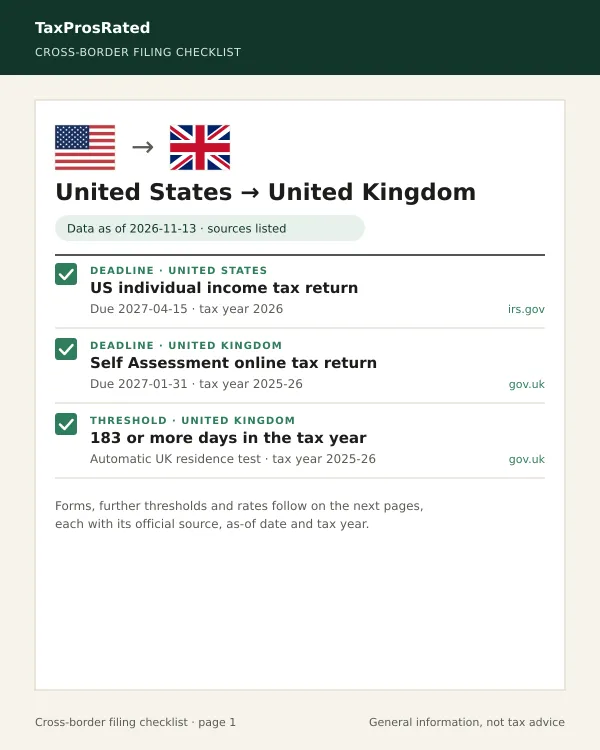
From TaxProsRated · our own product
Cross-border filing checklist
- A PDF and a web copy of the checklist for the country pair you choose
- Filing deadlines for both countries, each with the official source URL and as-of date
- The forms named by each tax authority, with a link to the authority's own page
$29 one-time · One payment, no renewal. Tax, if any, is shown at checkout.
More countries in this region · All jurisdictions · Panama filing deadlines · Panama in the tax rates index · Cross-border filing checklist
Change log
- Country summary updated
- Rate source updated: corporate-income Source
- Rate source updated: vat Source
- Rate source updated: personal-income-lowest Source
- Rate source updated: personal-income Source
- Rate added: corporate-income 25 Source
- Rate added: vat 7 Source
- Rate added: personal-income-lowest 15 Source
- Rate added: personal-income 25 Source
- Reviewed against Dirección General de Ingresos (DGI Panamá)
Sources
The figures, dates, and rules on this page are sourced from the documents listed below. Where two sources disagree, both are listed.
Important disclaimer
Informational only — not tax advice. This page summarises publicly available information about tax in Panama as of November 2026. Tax laws change, individual circumstances vary, and the application of any rule depends on your specific facts.
TaxProsRated does not provide tax, legal, accounting, or financial advice. Before acting on anything you read here, consult a qualified tax professional licensed in your jurisdiction (in the US: CPA, Enrolled Agent, or attorney; in the UK: CIOT- or ATT-qualified adviser; in Australia: TPB-registered tax agent; elsewhere: a locally-licensed equivalent). TaxProsRated, its operators, and its contributors disclaim all liability for action taken in reliance on this page.