
Country
Tax in Hong Kong Sourced summary, not advice.
 Tax in Hong Kong Sourced summary, not advice.
The Inland Revenue Department administers Hong Kong tax. Tax year (Year of Assessment) runs 1 April – 31 March; the BIR60 individual return is filed within one month of issue, typically May–June. Hong Kong applies a territorial source-of-income basis — only Hong Kong-source income is taxed. Tax in Hong Kong is administered by Inland Revenue Department.
Tax rates
Corporate income tax
Normal profits tax rate for corporations; two-tiered regime taxes first $2,000,000 at 8.25%
Top personal income tax
Top progressive salaries tax rate; tax is capped at the standard rate (15%, or 16% on net income above $5,000,000 from 2024/25); page is on GovHK (linked from IRD), last revised May 2026
Lowest personal income tax
Progressive salaries tax rate on first $50,000 of net chargeable income; page is on GovHK (linked from IRD)
Rate table
CSV| Tax | Rate | As of | Source |
|---|---|---|---|
| Corporate income tax | 16.5Normal profits tax rate for corporations | Inland Revenue Department | |
| Top personal income tax | 17Top progressive salaries tax rate | gov.hk | |
| Lowest personal income tax | 2Progressive salaries tax rate on first $50,000 of net chargeable… | gov.hk |
Who is the tax authority?
The Inland Revenue Department (IRD) administers Hong Kong tax under the Inland Revenue Ordinance (Cap. 112). The IRD operates as a department of the Hong Kong SAR Government under the Financial Secretary.
The IRD covers Salaries Tax, Profits Tax, Property Tax, Personal Assessment, Stamp Duty, and Business Registration. Estate duty was abolished for deaths on or after 11 February 2006 under the Estate Duty Ordinance (Cap. 111). The Customs and Excise Department handles narrow excise duties on alcohol, tobacco, hydrocarbon oil, and methyl alcohol — there is no general tariff or VAT.
Sponsored. We may earn a commission if you sign up through these links, at no cost to you. How we earn

The Hong Kong Institute of Certified Public Accountants (HKICPA) regulates the principal credentialed accounting profession. The Taxation Institute of Hong Kong runs the Certified Tax-Adviser designation for tax specialists.
What is the tax year and when are returns due?
Hong Kong's Year of Assessment (YA) runs from 1 April to 31 March. The 2025/26 YA covers 1 April 2025 to 31 March 2026.

The IRD typically issues individual Salaries Tax returns (BIR60) in May or June. Filers have one month from the issue date unless extension is granted via the Block Extension Scheme operated by registered tax representatives.
Companies file Profits Tax returns (BIR51 for corporations, BIR54 for partnerships) within one month of issue. Extended deadlines apply under the Block Extension Scheme based on accounting-year-end date.
How does Hong Kong determine source and residency?
Hong Kong applies a territorial basis of taxation — the key question is the source of income, not the residence of the person. Salaries Tax applies to employment income sourced in Hong Kong, with source determined under DIPN 10 (considering contract negotiation, employer residence, payment location, and duties location).
How does Salaries Tax work?
Salaries Tax for individuals is computed on the lower of two methods. The progressive method applies rates of 2%, 6%, 10%, 14%, and 17% to net chargeable income (after deductions and allowances). The standard-rate method caps the total Salaries Tax at 15% of net total income before personal allowances (or 16% on net total income above HKD 5 million under the two-tiered standard rate introduced from YA 2024/25).
| Net chargeable income (HKD) | Progressive rate |
|---|---|
| First 50,000 | 2% |
| Next 50,000 | 6% |
| Next 50,000 | 10% |
| Next 50,000 | 14% |
| Remainder | 17% |
| Standard Rate cap | 15% on net total income |
Personal allowances reduce the progressive base significantly. The Basic Allowance is HKD 132,000; the Married Person's Allowance is HKD 264,000; Child Allowance is HKD 130,000 per child. Dependent Parent or Grandparent Allowance ranges from HKD 50,000 to HKD 100,000 per dependant based on age.
Allowable outgoings include Mandatory Provident Fund contributions up to HKD 18,000 per year, qualifying Voluntary Health Insurance Scheme premiums, and home-loan interest up to HKD 100,000 per year on an owner-occupied principal residence (subject to a 20-year cumulative cap). Personal Assessment is an elective regime that combines Salaries Tax, Profits Tax on sole-proprietorship share, and Property Tax onto a single progressive base for certain taxpayers.
Property Tax applies at 15% on the net assessable value (NAV) of rental income from Hong Kong real estate. Owner-occupied properties are excluded from Property Tax.
How does Profits Tax work?
Hong Kong uses a two-tiered Profits Tax regime in force since Year of Assessment 2018/19. The regime applies to profits arising in or derived from Hong Kong — offshore profits remain outside the Profits Tax base under the territorial principle.
First HKD 2,000,000 of assessable profits. Restricted to one entity within a connected group.
Assessable profits above HKD 2,000,000. Full rate on all profits for connected-group second entities.
First HKD 2,000,000 of assessable profits for sole proprietorships and partnerships.
Assessable profits above HKD 2,000,000 for sole proprietorships and partnerships.
The Foreign-Source Income Exemption (FSIE) regime under Schedule 3 of the IRO was refined from 1 January 2023 (and further updated in 2024). Specified offshore passive income — interest, dividends, IP-derived income, and equity-disposal gains — received in Hong Kong by a resident entity is subject to Profits Tax unless economic-substance requirements and participation requirements are met.
Hong Kong enacted the OECD Pillar Two Global Anti-Base Erosion rules through the Inland Revenue (Amendment) (Minimum Tax for Multinational Enterprise Groups) Bill. The Income Inclusion Rule and Domestic Minimum Top-up Tax apply to MNE groups with consolidated revenue above EUR 750 million, for fiscal years beginning on or after 1 January 2025.
Is there VAT or indirect tax?
Hong Kong has no Value Added Tax, no Goods and Services Tax, and no general sales tax. This is one of the most distinctive features of the Hong Kong fiscal structure among major financial centres globally.
Hong Kong levies no VAT, GST, or general sales tax of any kind.
Stamp Duty applies on Hong Kong real-estate transfers and stock transfers (0.13% per side). Customs and Excise duties cover only alcohol, tobacco, hydrocarbon oil, and methyl alcohol. Air Passenger Departure Tax of HKD 120 applies per international departure. Business Registration is required for entities carrying on business in Hong Kong.
| Indirect tax | Rate / detail |
|---|---|
| VAT / GST | None |
| Stamp Duty — property transfers | Progressive (buyer + seller) |
| Stamp Duty — stock transfers | 0.13% per side |
| Customs and Excise | Alcohol / tobacco / fuel / methyl alcohol only |
| Air Passenger Departure Tax | HKD 120 per international departure |
| Hotel Accommodation Tax | Abolished 2008 |
| Estate Duty | Abolished 11 Feb 2006 |
How are cryptoassets taxed?
The IRD applies the territorial framework to cryptoassets under Departmental Interpretation and Practice Note No. 39 (DIPN 39). A badges-of-trade analysis determines whether disposal gains are of a capital or trading nature.
What is the treaty network?
Hong Kong maintains approximately 50 Comprehensive Avoidance of Double Taxation Agreements (CDTAs) in force. The network is smaller than major sovereign-jurisdiction networks, reflecting Hong Kong's status as a Special Administrative Region rather than a sovereign state.
Most Hong Kong CDTAs follow the OECD Model Convention with Hong Kong-specific reservations on source-of-income provisions, reflecting the territorial taxation basis. Hong Kong is not a direct party to the OECD Multilateral Instrument (MLI) — the MLI is open only to OECD member states, and China (as the OECD-relevant party for SAR purposes) holds Hong Kong's position. Bilateral CDTA modifications proceed via individual protocol.
Hong Kong has no comprehensive income tax treaty with the United States. US persons working or investing in Hong Kong must rely on the US Foreign Tax Credit under the Internal Revenue Code rather than bilateral reduced withholding rates. Hong Kong signed the OECD Inclusive Framework on BEPS and implements the BEPS minimum standards through domestic legislation.
Where does Hong Kong sit in the Greater China financial hub cohort?
Hong Kong anchors the Greater China financial hub cohort alongside Singapore and Macau. The broader Asia-Pacific tax landscape splits into 5 distinct archetypes:
Common pitfalls and penalties
Foreigners and new arrivals in Hong Kong encounter a predictable set of traps:
New arrivals sometimes assume Hong Kong residency triggers worldwide-income taxation. It does not — the territorial basis means only HK-source income is taxed. Foreign income remains outside the Salaries Tax base.
Since 1 January 2023 the FSIE regime subjects specified offshore passive income (interest, dividends, IP income, equity-disposal gains) to Profits Tax unless economic-substance or participation requirements are met. Many holding structures built before 2023 need review.
Short-term business visitors on Hong Kong-source employment can be exempt from Salaries Tax under section 8(1A)(c) IRO if they are present no more than 60 days in the YA. Failure to track days can result in unexpected tax exposure for frequent business travelers.
The Provisional Tax mechanism collects tax in advance. Filers who experience a material income drop can apply for a holdover of provisional tax, but the window is short. Missing the holdover deadline means paying provisional tax on income not yet earned.
The 8.25% reduced rate on the first HKD 2 million of profits applies to only one entity within a connected group. Structures with multiple HK companies cannot stack the lower tier — only one entity qualifies per group.
MNE groups with consolidated revenue above EUR 750 million are subject to the OECD Global Minimum Tax (15%) via Hong Kong's Domestic Minimum Top-up Tax from 1 January 2025. Structures relying on pre-2025 low-rate assumptions may face unexpected top-up charges.
US persons in Hong Kong cannot rely on a bilateral treaty to reduce withholding rates. The lack of a US–HK comprehensive DTA means US individuals depend on the US Foreign Tax Credit under domestic IRC rules. Cross-border structures involving US persons need specialist review.
Late filing of a Salaries Tax or Profits Tax return triggers fines from HKD 1,200 to HKD 10,000 plus up to three times the under-declared tax in serious cases under sections 80(2)–(3) and 82A IRO. Late payment triggers a 5% surcharge after the due date and a further 10% six months later.
More on Hong Kong
The rest of the Hong Kong reference is on the Hong Kong tax guide.
Frequently asked
Who is the tax authority in Hong Kong?
The Inland Revenue Department (IRD) administers the Inland Revenue Ordinance (Cap. 112) covering Salaries Tax, Profits Tax, Property Tax, and Personal Assessment; Stamp Duty Ordinance (Cap. 117); legacy Estate Duty Ordinance; and Business Registration. No VAT. Customs and Excise handles narrow excise. HKICPA regulates CPAs; Taxation Institute of Hong Kong runs the Certified Tax-Adviser credential.
What is the Hong Kong tax year and the filing deadline?
Year of Assessment runs 1 April to 31 March. BIR60 individual returns issued May/June, due within one month unless extension granted. Block Extension Scheme provides longer deadlines via registered tax representative. Provisional Tax in two instalments. Companies file BIR51/BIR54 within one month of issue with Block Extension by accounting-year-end.
How is Hong Kong tax residency determined?
Hong Kong applies territorial basis, not residency basis. Salaries Tax on employment with Hong Kong source under DIPN 10 framework. Profits Tax on profits arising in or derived from Hong Kong. Property Tax on Hong Kong-real-estate rental. 60-day exemption under section 8(1A)(c) IRO. Treaty-residency for CDTA access via ordinary residence, 180 days in YA, or 300 days across two YAs.
How does Hong Kong personal income tax work?
Salaries Tax: lower of progressive (2/6/10/14/17 percent on net chargeable income up to HKD 200,000 then 17 percent above) OR Standard Rate 15 percent on net total income before allowances (16 percent above HKD 5m under two-tiered Standard Rate from 2024/25). Personal allowances Basic HKD 132,000, Married HKD 264,000, plus dependants. MPF + home-loan-interest allowable outgoings.
How does Hong Kong corporate tax work?
Two-tiered Profits Tax since YA 2018/19: 8.25 percent on first HKD 2m corporations (7.5 percent unincorporated); 16.5 percent above (15 percent unincorporated). Restricted to one entity within connected group. Offshore profits exempt under territorial principle, with FSIE regime catching specified offshore passive income unless economic-substance met. Pillar Two GMT applies for fiscal years beginning on or after 1 January 2025.
How does indirect tax work in Hong Kong?
No VAT, no GST, no general sales tax. Stamp Duty on real-estate transfers and stock transfers (0.13 percent per side). Customs and Excise duties only on alcohol, tobacco, hydrocarbon oil, methyl alcohol — no general customs tariff. Air Passenger Departure Tax HKD 120 on international flights. Business Registration required for entities carrying on business.
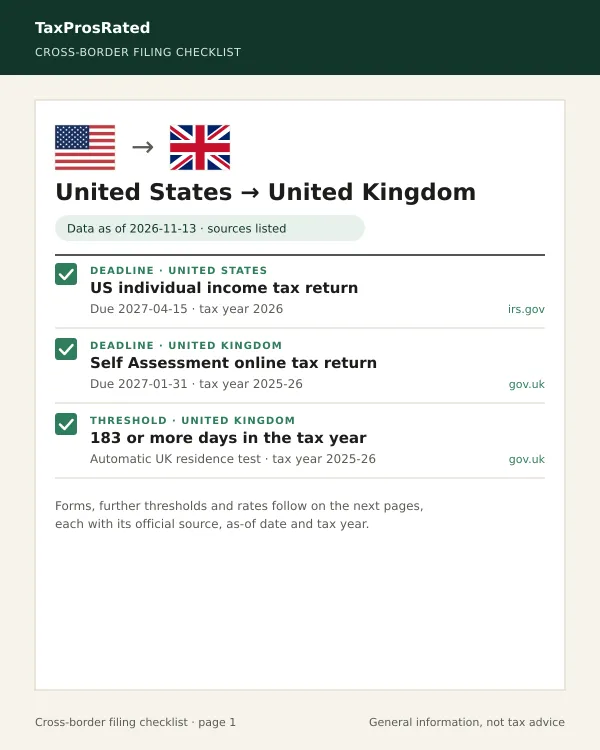
From TaxProsRated · our own product
Cross-border filing checklist
- A PDF and a web copy of the checklist for the country pair you choose
- Filing deadlines for both countries, each with the official source URL and as-of date
- The forms named by each tax authority, with a link to the authority's own page
$29 one-time · One payment, no renewal. Tax, if any, is shown at checkout.
More countries in this region · All jurisdictions · Hong Kong filing deadlines · Hong Kong in the tax rates index · Cross-border filing checklist
Hong Kong tax guides
In-depth guides and explainers relevant to Hong Kong.
Change log
- Rate source updated: corporate-income Source
- Rate source updated: personal-income-lowest Source
- Rate source updated: personal-income Source
- Rate source updated: inheritance
- Rate source updated: capital-gains
- Rate source updated: vat
- Rate updated: corporate-income from 16.5% to 16.5 Source
- Rate added: personal-income-lowest 2 Source
- Rate updated: personal-income Up to from 16% to 17 Source
- Country summary updated
- Reviewed against Inland Revenue Department
Sources
The figures, dates, and rules on this page are sourced from the documents listed below. Where two sources disagree, both are listed.
Important disclaimer
Informational only — not tax advice. This page summarises publicly available information about tax in Hong Kong as of November 2026. Tax laws change, individual circumstances vary, and the application of any rule depends on your specific facts.
TaxProsRated does not provide tax, legal, accounting, or financial advice. Before acting on anything you read here, consult a qualified tax professional licensed in your jurisdiction (in the US: CPA, Enrolled Agent, or attorney; in the UK: CIOT- or ATT-qualified adviser; in Australia: TPB-registered tax agent; elsewhere: a locally-licensed equivalent). TaxProsRated, its operators, and its contributors disclaim all liability for action taken in reliance on this page.