
Country
Tax in South Korea Sourced summary, not advice.
 Tax in South Korea Sourced summary, not advice.
The National Tax Service administers Korean tax. Tax year is the calendar year; the personal Comprehensive Income Tax return is due 31 May following year-end. Residents are taxed on worldwide income at progressive rates 6–45 percent plus 10 percent local resident-tax surcharge. Tax in South Korea is administered by National Tax Service (NTS).
KR notes on this page are the question-and-answer record already researched for KR. Read the cited government page before treating a figure as current, and speak with a qualified professional in KR about a filing.
South Korea's capital gains levy (yang-do-so-deuk-se, 양도소득세) is administered by the National Tax Service (NTS, 국세청) under the Income Tax Act (So-deuk-se-beob, 소득세법). The tax distinguishes sharply between asset classes: residential real estate carries steep progressive rates with holding-period penalties designed to cool speculation, while listed-share gains are largely exempt for the country's 14-plus million retail investors.
How does Korea tax real estate capital gains?
Gains on residential real estate held for two or more years are taxed using the same eight progressive brackets as ordinary income -- 6% up to KRW 14 million of gain, scaling through 15%, 24%, 35%, 38%, 40%, 42%, and 45% above KRW 1 billion -- plus a mandatory 10% local income tax surtax on the national amount (effective top rate 49.5%). Short holding periods trigger flat penalty rates: property sold within one year of acquisition is taxed at 70% (77% including local tax) for residential houses; property sold in the one-to-two-year window faces 60% (66% with local tax). These elevated short-term rates were enacted through the 2020 Tax Law Amendments and became effective for transactions on or after June 1, 2021. A basic annual deduction of KRW 2.5 million offsets the taxable gain before the rate table applies. Source: NTS rate schedule (nts.go.kr, Article 104 So-deuk-se-beob). South Korea country overview
What is the one-household one-home exemption?
A household owning exactly one residential house in Korea and meeting minimum ownership and residency conditions is generally exempt from capital gains tax on the sale of that home. As of 2025, the exemption applies in full where the sale price does not exceed KRW 1.2 billion (raised from KRW 900 million under the 2025 tax revision). For higher-value homes above the KRW 1.2 billion ceiling, only the gain attributable to the portion above the threshold is taxable.
Sponsored. We may earn a commission if you sign up through these links, at no cost to you. How we earn

Minimum conditions are: at least two years of ownership, and, for homes in a designated adjustment-target zone (jojeong daeseang jiyeok), at least two years of actual residence. Single-home owners who held and resided in the property for ten or more years may also claim the long-term holding special deduction (janggi boyu teukbyeol gongje, 장기보유특별공제) at a combined rate of 4% per year for the holding period plus 4% per year for the residence period, capped at 80% of the gain -- reducing the effective taxable base to as little as 20% of the gross gain. Source: NTS, Asiae English edition (December 2024 economic policy announcement).
What surcharges apply to multi-home owners?
Owners of two or more residential properties face additional capital gains tax surcharges of 20 to 30 percentage points on top of the base progressive rates when they sell, bringing the effective national rate as high as 75% before local tax. The surcharge structure -- introduced under the Moon Jae-in administration's 2020 housing-market intervention -- was placed under a rolling moratorium by the Yoon Suk-yeol administration beginning May 2022 to stimulate transactions.
That moratorium was extended annually and most recently prolonged to May 9, 2026 as part of the government's 2025 Economic Policy Direction announced in December 2024 (source: Asiae English, Korea Times). The moratorium expired on schedule on May 11, 2026 without further extension; multi-home owners selling from that date face the full surcharge, potentially reaching an effective rate of 82.5% (national plus local) on gains from properties in overheated-designation zones.
Owners who completed contracts before the May 11, 2026 deadline remain protected under the moratorium rules. Given the complexity and policy volatility of the multi-home surcharge framework, individuals in this category are encouraged to verify current rules with a qualified tax professional.
Are listed-share gains exempt for retail investors?
Gains from selling shares listed on the Korea Exchange (KRX) are exempt from capital gains tax for investors who fall below the large-shareholder threshold. A shareholder is classified as a large shareholder (dae-ju-ju, 대주주) under Article 94 of the Income Tax Act if they hold 1% or more of a company's total issued shares (direct plus related-party holdings), OR if the aggregate market value of their holdings in one company reaches KRW 5 billion or more at the preceding December 31 year-end measurement date.
Large shareholders pay 22% (including 2% local income tax) on gains from shares held one year or more, and 25% (including local tax) on shares held less than one year. Gains on unlisted company shares are taxable regardless of holding size: 22% for small-to-medium enterprises (SMEs) and 25% for large company shares; SME-qualifying holdings under the Special Tax Treatment Limitation Act may access a reduced 11% rate.
The KRW 5 billion threshold was restored to its current level by the Yoon administration in December 2023 after a prior proposal to lower it to KRW 1 billion was withdrawn under retail-investor pressure; a September 2025 proposal to cut it to KRW 1 billion was similarly scrapped (source: KED Global, September 2025).
What happened to the Financial Investment Income Tax (FIIT)?
The Financial Investment Income Tax (Geum-yung-tu-ja-so-deuk-se, 금융투자소득세 -- FIIT) was a proposed unified levy that would have taxed annual gains from listed shares, bonds, funds, ETFs, and derivatives exceeding KRW 50 million at 22% (25% for gains above KRW 300 million). Originally announced in 2020 for a 2023 start, it was deferred twice.
In December 2024 the National Assembly formally abolished the FIIT through the 2025 Tax Law revision before the January 2025 implementation date, motivated by concern that the new tax would drive domestic retail capital toward overseas markets and deepen the so-called Korea Discount on KRX valuations. The existing listed-share retail-investor exemption therefore remains in force as of 2026. Note: the FIIT abolition did not affect cryptocurrency -- a separate 22% levy on virtual-asset income gains above KRW 2.5 million is now scheduled to take effect for transactions beginning January 1, 2027, with first filings in 2028.
When and how is capital gains tax filed?
Real estate disposals require a preliminary return filed within two months of the end of the month in which the transfer occurred -- for example, a property sold in March means a return due by May 31. Sellers who fail to file a preliminary return must complete an annual final return during the NTS general filing window of May 1 to May 31 (or June 1 in leap-year adjusted years) for the preceding calendar year. For securities, large shareholders who sold listed shares during January to June file a preliminary return by August 31; those selling July to December file by March 31 of the following year. The NTS enforces capital gains compliance actively: in May 2026 the NTS issued filing notices to approximately 220,000 taxpayers for 2025 gains, including roughly 10,000 for real estate disposals. Failure to file carries a 20% underpayment penalty plus 0.022% per day interest on unpaid tax. Source: NTS English guide (nts.go.kr/english), Seoul Economic Daily May 2026.
Capital gains tax in Korea is a fact-specific area shaped by property classification, holding duration, household configuration, and current zoning designations. Verify your specific situation with a qualified tax professional before relying on general rate information.
South Korea capital gains tax: real estate progressive rates, short-hold penalties, and the FIIT that was scrapped
South Korea taxes real estate gains progressively at 6-45% (national) with 70% for sub-one-year holds; one-household one-home sales under KRW 1.2 billion are generally exempt. Listed-share gains are exempt for retail investors below the KRW 5 billion large-shareholder threshold. The Financial Investment Income Tax (FIIT) was formally abolished by the National Assembly in December 2024 before it could take effect.
Is the Financial Investment Income Tax (FIIT) still going to take effect in Korea?
No. The FIIT was formally abolished by the Korean National Assembly in December 2024 before its scheduled January 2025 start date. The planned 22% levy on financial investment income above KRW 50 million (listed shares, bonds, funds, derivatives) no longer exists. The existing listed-share retail-investor exemption remains in place as of 2026.
What is the capital gains tax rate for a Korean house sold within one year?
A residential property sold within one year of acquisition is subject to a 70% national capital gains tax rate, plus a 10% local income tax surtax on the national amount, for an effective combined rate of 77%. Properties sold in the one-to-two-year window face 60% national (66% combined). These penalty rates were introduced by the 2020 tax amendments effective June 1, 2021.
When does the one-household one-home exemption apply?
A household owning exactly one residential property is generally exempt from capital gains tax if the sale price does not exceed KRW 1.2 billion (about USD 870,000), the property was owned at least two years, and residency requirements are met. For homes in designated adjustment zones, at least two years of actual residence is also required. Gain above the KRW 1.2 billion price ceiling remains taxable.
Have the multi-home owner surcharges expired or been extended?
The moratorium on multi-home surcharges expired on May 11, 2026 without further extension. From that date, owners selling a second or additional home face surcharges of 20 to 30 percentage points on top of the standard progressive 6-45% rates, potentially reaching a combined effective rate of 82.5% in overheated-designation zones. Contracts completed before May 11, 2026 remain protected under the prior moratorium rules.
At what threshold are Korean listed-share gains taxable for individual investors?
Listed-share capital gains are exempt for investors below the large-shareholder threshold: holding less than 1% of a company's issued shares AND holding a year-end market value below KRW 5 billion in one company. Above either threshold, gains are taxed at 22% (held one year or more) or 25% (under one year), including local income tax. The KRW 5 billion threshold was confirmed at that level in September 2025 after a proposed cut to KRW 1 billion was abandoned.
South Korea has a detailed statutory framework for taxing virtual asset gains, but its core provisions have not yet entered into force. The disposal-gains framework under Article 21 of the Income Tax Act (So-deuk-se-beob) has been deferred three times since 2020, most recently pushed from 1 January 2025 to 1 January 2027 by amendments enacted in December 2024. Until 2027, individuals who buy and sell cryptocurrency realise no separately-taxable capital income event under Korean law. Two other tax heads, however, apply today: inheritance and gift tax on transferred crypto holdings, and ordinary miscellaneous income tax on mining and staking rewards.
When will crypto disposal gains be taxed in South Korea?
The National Tax Service (NTS) and Ministry of Economy and Finance confirmed in December 2024 that the virtual-asset capital-gains framework will take effect on 1 January 2027, following three prior deferrals (from 2022, then 2023, then 2025).
The Korea Times reported in November 2025 that a fourth deferral cannot be ruled out, citing continued gaps in exchange-reporting infrastructure and unresolved definitional issues around airdrops, staking, hard forks, and lending income. No legislative change had been enacted as of the date of this review.
What is the structure of the planned 2027 framework?
Under the framework scheduled for 2027, the taxable amount equals total in-year disposal proceeds minus aggregate acquisition cost (using the moving-average method) minus ancillary transaction expenses minus the KRW 2.5 million annual exemption. The 22% combined rate applies to the net positive remainder.
Losses may offset gains within the same calendar year across virtual asset disposals, but cannot offset other income categories such as employment or listed-share gains, and there is no loss carry-forward provision. The framework parallels Korea's existing treatment of capital gains on shares held by substantial shareholders, which also carries a 22% combined rate.
Are crypto gains taxed at all before 2027?
For disposal gains, generally no. A Korean-resident individual who buys and later sells cryptocurrency before 1 January 2027 does not trigger a separately-taxable capital-gains event under current law. However, two existing tax heads reach crypto today. First, mining and staking rewards are taxable as miscellaneous income (gi-ta-so-deuk) under the present version of Article 21 of the Income Tax Act, recognised at fair market value in KRW on the date of receipt and taxed at the individual's applicable progressive rate (6% to 45%, plus 10% local surcharge).
Second, transfers of crypto by gift or inheritance trigger gift and inheritance tax under the Inheritance and Gift Tax Act. Since February 2025, virtual assets subject to those taxes are valued at the average market price over the one-month period before and the one-month period after the transfer date, a methodology promulgated by the Ministry of Economy and Finance. Standard inheritance and gift tax exemptions and rates apply; the crypto-specific rule addresses valuation methodology only.
What enforcement activity is NTS running now?
Although the disposal-gains framework is not yet in force, the NTS is actively building enforcement infrastructure. In April 2026 the NTS announced an Integrated Virtual Asset Analysis System to verify the source of funds in property purchase transactions and identify undisclosed crypto income used in real estate acquisitions, with a pilot launch scheduled for November 2026. The NTS has also contracted with blockchain-analytics firms Chainalysis and TRM Labs to track non-custodial and cold-wallet holdings.
Separately, the NTS confirmed in 2026 that South Korea will begin receiving virtual asset transaction data from 56 partner countries under the OECD Crypto-Asset Reporting Framework (CARF) in 2027. Qualified virtual asset service providers (VASPs) registered under the Virtual Asset User Protection Act (effective 19 July 2024) are already required to submit quarterly transaction statements to the NTS by month-end following each quarter, and annual statements by month-end following the fiscal year, under provisions that took effect in 2023 and 2024. Non-compliance from 1 January 2026 can trigger fines of up to KRW 20 million.
How does Korea's framework compare with regional peers?
The table below places the planned Korean framework alongside key Asian jurisdictions as of mid-2026. Korea's 22% flat rate sits between the tax-exempt treatment in Singapore and Hong Kong and the high-rate progressive treatment in Japan.
| Jurisdiction | Individual crypto disposal | Rate / threshold | Status |
|---|---|---|---|
| South Korea | Taxable as other income | 22% combined on gain above KRW 2.5 million/year | Deferred to 1 Jan 2027 |
| Japan | Taxable as miscellaneous income | Progressive up to 55% (national + local) | In force |
| Singapore | Not taxable (no capital-gains tax) | N/A | In force |
| Hong Kong | Not taxable for individuals | N/A | In force |
| Australia | Capital gains tax applies | 50% discount if held over 12 months | In force |
Consult a qualified professional before making any cross-border residency or holding decisions based on this comparison.
For further background on South Korea's broader tax residency rules and how resident status determines exposure to the 2027 framework, see the South Korea country overview and the linked expat tax residency crossover for non-residents holding Korean-exchange crypto.
The rules described here are based on publicly available statutory and regulatory sources as of June 2026. Korea's virtual asset framework is actively evolving. Individuals with material crypto holdings, staking income, or cross-border exchange exposure should consult a Korean Certified Tax Accountant (se-mu-sa) or a qualified international tax professional for guidance specific to their circumstances.
Crypto Taxation in South Korea: 22% Rate Deferred to January 2027
South Korea's planned 22% combined tax (20% national plus 2% local) on individual crypto gains above KRW 2.5 million per year has been deferred three times and is now scheduled to take effect on 1 January 2027. Until then, gains from disposing of cryptocurrency are generally not taxed as capital income for individuals; mining and staking rewards remain taxable as miscellaneous income under existing law.
Is cryptocurrency taxed in South Korea right now?
Disposal gains from buying and selling cryptocurrency are not taxed as capital income for individuals under current Korean law; the framework has been deferred to 1 January 2027. Mining and staking rewards are already taxable as miscellaneous income at the individual's progressive rate. Transfers of crypto by gift or inheritance are subject to existing inheritance and gift tax at standard rates and thresholds.
What rate and threshold will apply when the 2027 framework takes effect?
The framework imposes a 22% combined rate (20% national income tax plus 2% local income tax surcharge) on annual net virtual asset gains exceeding KRW 2.5 million. The taxable amount is calculated as total disposal proceeds minus acquisition cost using the moving-average method minus ancillary expenses minus the KRW 2.5 million annual exemption. Losses may offset gains within the same year but cannot be carried forward.
Why has the crypto tax been deferred three times?
The Korea Times and Ministry of Economy and Finance have cited three converging factors: unresolved definitional gaps for income types such as airdrops, staking rewards, hard forks, and lending income; underdeveloped reporting infrastructure between exchanges and the NTS; and political sensitivity around a young investor base that is disproportionately exposed to cryptocurrency markets. A fourth deferral beyond 2027 has not been ruled out by researchers.
How are crypto gifts and inherited crypto taxed in South Korea today?
Transfers of virtual assets by gift or inheritance are subject to Korean inheritance and gift tax at standard rates and exemptions. Since February 2025, valuation follows a methodology established by the Ministry of Economy and Finance: the average market price across the one month before and the one month after the transfer date.
Professional appraisals are excluded from this valuation process. Corporate holders shifted from FIFO to a total-average cost method at the same time.
More on South Korea
The rest of the South Korea reference is on the South Korea tax guide, in 3 parts: part 1, part 2, part 3.
- What enforcement steps is the NTS taking before 2027?
- What rate is withheld on dividends and interest?
- How does the KRW 20 million financial-income aggregation rule work?
- What happened to the Financial Investment Income Tax (FIIT)?
- How are foreign dividends taxed and what treaty relief applies?
- What is the securities transaction tax and what are the current rates?
- Dividend and Investment Tax in South Korea: 14% Withholding, KRW 20 Million Aggregation, FIIT Repeal, and the Securities Transaction Tax (2026)
- What is the withholding rate on dividends paid to a Korean resident?
- What triggers comprehensive taxation on investment income in South Korea?
- Was the Financial Investment Income Tax (FIIT) enacted?
- How are foreign dividends taxed for a Korean resident?
- What is the securities transaction tax rate on Korean listed shares in 2026?
- Who is a Korean tax resident?
- What is the five-year rule for newly arrived foreign nationals?
- What are the progressive income tax rates?
- How does the 19% flat-rate election work for foreign employees?
- What registration and filing obligations apply?
- Expat Tax Residency in South Korea: 183-Day Rule, 5-Year Foreign-Source Shelter, and the 19% Flat-Rate Election
- When does a foreign national become a Korean tax resident?
- What is the five-year rule for foreign residents in South Korea?
- How does the 19% flat-rate election for foreign workers operate?
- What are South Korea's personal income tax rates and brackets?
- When must Korean expat tax returns be filed, and what records are required?
- What inheritance tax rates does South Korea apply?
- What deductions reduce the taxable estate?
- How does the controlling-shareholder premium work -- and was it eliminated?
- What gift tax rules apply, and how do deductions vary by relationship?
- What are the 2025-2026 reform proposals, and which are enacted?
- Inheritance and Gift Tax in South Korea: Rates, Deductions, and the Proposed 2028 Reform
- What is the top inheritance tax rate in South Korea and when does it apply?
- How does the spousal deduction work for Korean inheritance tax?
- What is the lump-sum deduction and who can use it?
- What gift tax deductions apply between parents and children in Korea?
- When must Korean inheritance tax returns be filed?
- What is the annual local Property Tax (jaesan-se) and how is it calculated?
- How does the Comprehensive Real Estate Holding Tax (jonghap budongsan-se) work?
- What acquisition tax applies when purchasing property?
- How are capital gains from selling Korean property taxed?
- What is the single-household, single-home capital gains exemption?
- What does the full property tax picture look like by scenario?
- South Korea Property Tax: Local Tax, Comprehensive Real Estate Holding Tax, Acquisition Tax, and Capital Gains (2026)
- What is the annual local Property Tax rate on a residential home in South Korea?
- Who pays the Comprehensive Real Estate Holding Tax and what is the threshold?
- What acquisition tax rate applies when buying a home in South Korea?
- Does South Korea have an exemption from capital gains tax when selling your home?
- Have South Korea's multi-home owner tax surcharges changed recently?
- What taxes does a Korean sole proprietor pay on business income?
- How does the simplified expense-rate (gyeongbi-yul) method reduce compliance burden?
- What bookkeeping method is legally required for each revenue tier?
- What VAT obligations apply to Korean sole proprietors?
- When must a sole proprietor file the comprehensive income tax return and the November interim prepayment?
- What social insurance applies to the self-employed?
- Self-Employed Tax in South Korea: Income Tax, VAT, and Social Insurance for Sole Proprietors
- What are the income tax rates and brackets for Korean sole proprietors in 2025?
- Who qualifies for the simplified VAT taxpayer (ganil) regime in South Korea?
- How does the November interim income tax prepayment work for sole proprietors?
- What social insurance contributions must Korean sole proprietors make?
- What is the simplified expense-rate (gyeongbi-yul) method and who can use it?
- What are the corporate income tax rates for small businesses?
- How are sole proprietors taxed?
- What is the VAT simplified taxpayer regime?
- What SME special tax reduction is available?
- What is the corporate interim prepayment obligation?
- Small-Business Tax in South Korea: Corporate and Sole-Proprietor Rates, VAT, and SME Reductions (2026)
- What is the combined corporate income tax rate for a small business earning under KRW 200 million in South Korea in 2026?
- Do sole proprietors in South Korea pay corporate income tax?
- What is the VAT exemption threshold for small businesses in South Korea?
- What SME special tax reduction is available under the Restriction of Special Taxation Act?
- When must Korean corporations make the interim corporate tax prepayment?
- How many tax treaties does Korea have, and what do they actually do?
- What are the domestic withholding rates, and how much can treaties reduce them?
- How does a non-resident claim a reduced withholding rate at source?
- How does the foreign tax credit work for Korean residents?
- What tie-breaker rule resolves dual residency?
- What are the Korea-US treaty specifics?
- How do Korea's anti-treaty-shopping rules work?
- South Korea Tax Treaty Relief: Reduced Withholding, Foreign Tax Credits, and the Korea-US Convention
- How many income tax treaties does South Korea have in force?
- What NTS forms must a foreign company submit to receive a reduced withholding rate?
- What are the Korea-US treaty withholding rates for dividends, interest, and royalties?
- How does the residence tie-breaker work when someone is a resident of both Korea and a treaty partner country?
- What changed in Korea's treaty application rules effective January 2026?
- What supplies are zero-rated versus exempt under Korean VAT?
- What is the simplified-taxpayer regime for small businesses?
- How do the two semi-annual taxable periods and quarterly returns work?
- What is the tax invoice (segyumgyesanseo) and the electronic mandate?
- How does Korea tax foreign digital service providers?
- South Korea VAT (Bugagachise): Flat 10%, Simplified-Taxpayer Regime, and the Electronic Tax Invoice Mandate
- What is the standard South Korean VAT rate and does it have reduced rates?
- What is the simplified-taxpayer threshold and how does the KRW 48 million sub-limit work?
- How do the two semi-annual VAT periods and quarterly preliminary returns interact?
- Who must issue electronic tax invoices and what are the transmission rules?
- How does Korea's VAT apply to foreign companies selling digital services?
Frequently asked
Who is the tax authority in Korea?
National Tax Service (NTS) — external organ of the Ministry of Economy and Finance — administers Income Tax Act, Corporate Tax Act, VAT Act, Inheritance and Gift Tax Act, and Comprehensive Real Estate Tax Act through 6 Regional Tax Offices and ~130 District Offices. Korea Customs Service handles customs. Local-government tax administrations handle Local Resident Tax. Sehak Sa and CPA are the principal credentialed professions.
What is the Korean tax year and the filing deadline?
Tax year is the calendar year. Comprehensive Income Tax return due 31 May following year-end. Year-End Tax Settlement (Yeonmaljeongsan) reconciles salary withholding in February. Salaried filers fully covered by settlement do not file separate Comprehensive return. Companies file Corporation Tax within 3 months of fiscal year-end. VAT returns quarterly by the 25th.
How is Korean tax residency determined?
Article 1-2 ITA: domicile (juso) or residence (geoso) in Korea for 1 year or more. Four tiers: Resident (worldwide), Non-Resident (Korean-source only), Short-Term Foreign Resident (Korean-source plus remitted foreign-source, for foreigners not resident more than 5 of last 10 years), Diplomat. Articles 118-9 to 118-13 ITA exit tax on substantial-shareholding emigrants.
How does Korean personal income tax work?
Eight-band progressive: 6/15/24/35/38/40/42/45 percent across KRW 14m / 50m / 88m / 150m / 300m / 500m / 1bn / above. Local Resident Tax 10 percent of national income tax — combined top ~49.5 percent. Standard Deduction plus dependants, credit-card spending, education/medical, mortgage-interest, National Pension. FIIT capital-gains tax further deferred to 1 January 2027.
How does Korean corporate tax work?
Four-band progressive from 1 January 2023: 9 percent to KRW 200m, 19 to 20bn, 21 to 300bn, 24 above. Local Resident Tax 10 percent of national corporate tax. Pillar Two GMT IIR applies via International Tax Coordination Act amendments from 1 January 2024; UTPR deferred to 2025. Article 17 ITCA CFC regime. Participation exemption for qualifying intra-group dividends.
How does indirect tax work in Korea?
VAT 10 percent flat since 1977. No reduced or super-reduced rate. Zero on exports and narrow set. Exempt: unprocessed foodstuffs, public transportation, financial services, medical, education, real-estate transfer, residential leases. Mandatory registration KRW 0 (Simplified for revenue under KRW 80m). Cross-border digital under Electronic Service Provider regime since 2015 (B2C) and 2019 (expansion).
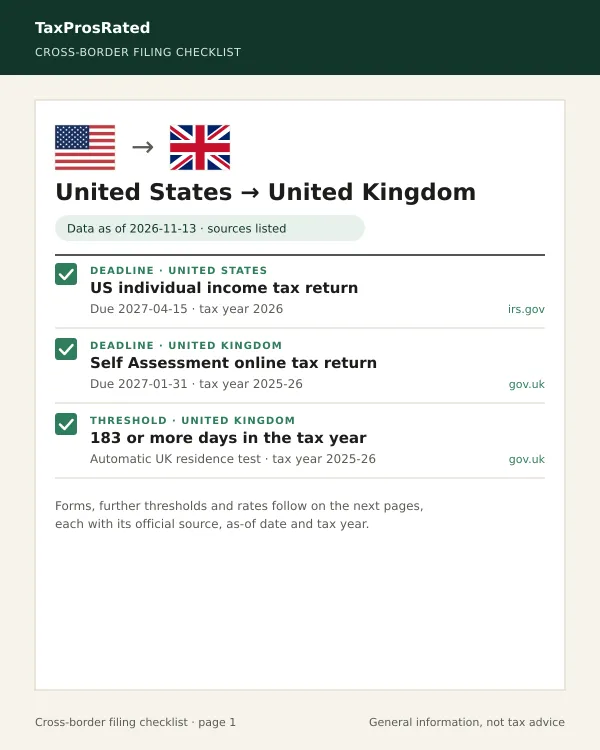
From TaxProsRated · our own product
Cross-border filing checklist
- A PDF and a web copy of the checklist for the country pair you choose
- Filing deadlines for both countries, each with the official source URL and as-of date
- The forms named by each tax authority, with a link to the authority's own page
$29 one-time · One payment, no renewal. Tax, if any, is shown at checkout.
More countries in this region · All jurisdictions · South Korea filing deadlines · South Korea in the tax rates index · Cross-border filing checklist
South Korea tax guides
In-depth guides and explainers relevant to South Korea.
Change log
- Country summary updated
- Country summary updated
- Reviewed against National Tax Service (NTS)
Sources
The figures, dates, and rules on this page are sourced from the documents listed below. Where two sources disagree, both are listed.
Important disclaimer
Informational only — not tax advice. This page summarises publicly available information about tax in South Korea as of November 2026. Tax laws change, individual circumstances vary, and the application of any rule depends on your specific facts.
TaxProsRated does not provide tax, legal, accounting, or financial advice. Before acting on anything you read here, consult a qualified tax professional licensed in your jurisdiction (in the US: CPA, Enrolled Agent, or attorney; in the UK: CIOT- or ATT-qualified adviser; in Australia: TPB-registered tax agent; elsewhere: a locally-licensed equivalent). TaxProsRated, its operators, and its contributors disclaim all liability for action taken in reliance on this page.