
Country
Tax in Belize Sourced summary, not advice.
 Tax in Belize Sourced summary, not advice.
Belize's Belize Tax Service (BTS) — formerly the Income Tax Department, consolidated 2020 — runs a gross-receipts Business Tax framework rather than a net-profit corporate income tax. Rates range from 1.75% on commission income to 25% on petroleum operations. Tax in Belize is administered by Belize Tax Service Department.
Who is the tax authority?
The Belize Tax Service (BTS) runs Belize's tax system. BTS was formed in 2020 when the Income Tax Department and the General Sales Tax Department merged under the Ministry of Finance.
The core statutes are the Income and Business Tax Act Cap 55, the General Sales Tax Act, and the Economic Substance Act 2019 (which governs International Business Companies post-reform). Belize is a CARICOM member and a SICA observer, giving it both Caribbean and Central American treaty and trade links.
Sponsored. We may earn a commission if you sign up through these links, at no cost to you. How we earn

The Institute of Chartered Accountants of Belize (ICAB) regulates the accounting profession locally.
What is the tax year and when are returns due?
Belize's default tax year is the calendar year (1 January to 31 December). Some businesses use the fiscal year running August 1 to July 31, but calendar year is the default for individuals. PAYE is withheld monthly from employee wages.

Business Tax returns for the prior fiscal year are due 31 March. GST-registered businesses file monthly returns. Monthly Business Tax remittances are due on the last day of the following month.
Who counts as a Belizean tax resident?
Belize taxes individuals primarily on Belize-source income under a territorial framework. Under the Income and Business Tax Act Cap 55, a person is treated as resident if they are ordinarily resident in Belize or are physically present 183 days or more in the tax year.
Residents are subject to PIT on Belize-source income. Foreign-source income remitted to Belize may also be taxable in certain circumstances. Non-residents pay tax only on Belize-source income.
Deep-dive: see expat and cross-border tax in Belize for the practical rules around the 183-day test and source-income scope.
What are the personal income tax rates?
Belize uses a flat 25% personal income tax rate above a personal allowance. The allowance creates an effective zero-tax band for lower earners.
| Income level (BZD) | Rate |
|---|---|
| Up to 26,000 (personal allowance) | 0% |
| Above 26,000 (chargeable income) | 25% flat |
Belize's PIT is structurally simple — one rate for everyone above the BZD 26,000 personal allowance. Pensioners receive a slightly higher allowance. Social Security contributions (4% employee / 4.5% employer) apply separately.
The flat rate means the effective tax burden is progressive in practice. Someone earning BZD 30,000 pays 25% on BZD 4,000 — an effective rate under 4% of total income.
Social Security contributions apply on top of income tax:
| Charge | Employee | Employer | Self-employed |
|---|---|---|---|
| Social Security | 4% | 4.5% | 7% |
Deep-dive: see self-employed tax in Belize for how Social Security and PIT combine for sole traders.
How does Business Tax work? (Gross-receipts, not net-profit)
Belize's headline distinction in the Caribbean-Central America cohort is the gross-receipts Business Tax framework. Most countries levy corporate income tax on net profit after deductions. Belize charges a percentage of gross turnover — no deduction for cost of goods sold or operating expenses at the business-tax level.
Rates vary sharply by business sector:
Agents, brokers, commissions on gross receipts.
Retail/wholesale commercial services on gross receipts.
Legal, accounting, consulting on gross receipts.
Rental income from real property on gross receipts.
Upstream oil/gas on gross receipts — highest sector rate.
A professional firm billing BZD 200,000 in Belize pays 6% Business Tax on the full BZD 200,000 (= BZD 12,000) regardless of its actual profit. Under a typical net-profit CIT at 25%, the same firm would pay tax only on its profit after salaries, rent, and expenses. Low-margin businesses can face a higher effective burden under the Belize gross-receipts framework.
Withholding tax on dividends paid to non-residents is 15%. Treaty partners may receive reduced rates. Pillar Two global minimum tax is not yet transposed in Belize. Business losses under the gross-receipts framework do not reduce Business Tax liability — the tax applies regardless of profitability.
Deep-dive: see small business tax in Belize for a worked gross-receipts vs net-profit comparison.
What about GST and other indirect taxes?
General Sales Tax (GST) is Belize's VAT equivalent, charged under the General Sales Tax Act.
| Rate | Applies to |
|---|---|
| 12.5% | Standard rate — most goods and services |
| 0% | Exports (zero-rated, not exempt) |
| 0% | Basic food items, school supplies, medicines (zero-rated) |
GST registration is mandatory once annual taxable supplies exceed the registration threshold. Businesses filing monthly GST returns submit them on the last working day of the following month. Customs duties and stamp duties apply to imports and property transfers respectively.
Deep-dive: see GST and indirect tax in Belize for the full GST mechanics and zero-rating rules.
How are cryptoassets taxed?
Belize has no dedicated crypto-asset tax law. The Central Bank of Belize has issued cautionary advisories about cryptoassets, but where they are declared, gains fall under existing income-tax or Business Tax categories depending on whether the activity is casual or commercial.
What is the IBC reform and Economic Substance Act?
Pre-2019, Belize was known for International Business Companies (IBCs) that paid 0% tax. The Economic Substance Act 2019 changed that significantly.
Belize IBCs incorporated before 2019 enjoyed full tax exemption under the International Business Companies Act. This attracted holding companies and financial structures from around the world.
The Economic Substance Act 2019 and subsequent IBC amendments require IBCs with relevant activities (finance, IP holding, distribution, headquarters) to demonstrate genuine Belize presence. IBCs now report to BTS and face standard Business Tax if operating in Belize.
The EU Code of Conduct scrutiny of Belize's offshore regime was the driver for reform. Companies that maintained shell structures without real operations in Belize risk penalties under the Economic Substance framework. A qualified local Tax-Adviser can assess whether existing IBC structures remain compliant.
Deep-dive: see IBC and Economic Substance in Belize for the reporting requirements and substance tests.
What is the treaty network?
Belize has approximately 14 active bilateral double tax agreements. Key partners include the United Kingdom, Austria, Belgium, Czech Republic, Denmark, Switzerland, UAE, and CARICOM peers via the CARICOM Multilateral Tax Convention.
Belize has signed but not ratified the OECD Multilateral Instrument (MLI). Belize is a signatory to the BEPS Inclusive Framework. The CARICOM Multilateral Tax Convention provides regional coverage among Caribbean member states.
Deep-dive: see tax treaty relief in Belize for the bilateral rate schedules.
Where does Belize sit in the Central America and Caribbean cohort?
Belize occupies a unique position — it sits geographically in Central America alongside Guatemala, Honduras, and Mexico, but its legal system, language, and CARICOM membership place it firmly in the Caribbean cohort. No other Central American country operates under English common law.
Currency framework
Belize uses the Belize Dollar (BZD), which has been pegged at a fixed rate of 2 BZD to 1 USD since 1976. This is one of the most durable currency pegs in the Americas.
The fixed peg means USD-denominated contracts convert predictably to BZD for tax purposes. Foreign investors do not face exchange-rate risk relative to the US dollar, which simplifies cross-border Business Tax calculations.
Tax obligations are denominated in BZD. Businesses with USD revenues report in BZD at the fixed 2:1 rate.
English common law — Belize's distinctive legal heritage
Belize is the only country in Central America that operates under English common law. Every other nation in the region — Guatemala, Honduras, El Salvador, Nicaragua, Costa Rica, Panama — uses civil law codes derived from the Spanish tradition.
English common law means Belize courts interpret tax statutes using precedent — a concept absent in civil-law systems. UK and Caribbean case law is persuasive authority in Belize courts. Practitioners trained in the UK, Australia, or other Commonwealth jurisdictions will find the analytical framework familiar, but local statute knowledge remains essential.
Belize is also a Commonwealth realm — it maintains ties to the Commonwealth of Nations, which informs its accounting standards (IFRS-aligned), audit regulation (ICAB credentialing), and treaty negotiation patterns.
More on Belize
The rest of the Belize reference is on the Belize tax guide.
Frequently asked
Who is the Belizean tax authority?
The Belize Tax Service (BTS), under the Ministry of Finance. BTS was formed in 2020 from the merger of the Income Tax Department and the General Sales Tax Department. BTS administers income tax, Business Tax, and GST under the Income and Business Tax Act Cap 55 and the General Sales Tax Act.
When is the Belizean annual return due?
PAYE withheld monthly. Personal income tax returns due 31 March for the prior calendar year. Business Tax annual returns due 31 March. Monthly Business Tax remittances due on the last day of the following month. GST monthly returns due on the last working day of the following month.
Who is a Belizean tax resident?
Tax residents are ordinarily resident in Belize OR physically present 183 days or more in the tax year. Belize operates a predominantly territorial framework — residents pay tax on Belize-source income, with foreign-source remittances potentially also subject to tax.
What are the Belizean personal income tax rates?
Flat 25% PIT on chargeable income above the BZD 26,000 personal allowance (BZD 26,000 for pensioners and standard). Social Security 4% employee / 4.5% employer. Earnings below BZD 26,000 are effectively tax-free.
How does Belize's Business Tax work?
Belize charges a gross-receipts Business Tax rather than a net-profit corporate income tax. Rates by sector: 1.75% commission income, 3% commercial services, 6% professional services, 8% real estate rents, 25% petroleum operations. Tax applies on gross turnover regardless of profitability. IBC framework reformed under Economic Substance Act 2019. Withholding on non-resident dividends 15%. Pillar Two not yet transposed.
What is the Belizean GST rate?
General Sales Tax is 12.5% standard rate under the GST Act. Exports are zero-rated (not exempt). Basic food items, school supplies, and medicines are also zero-rated.
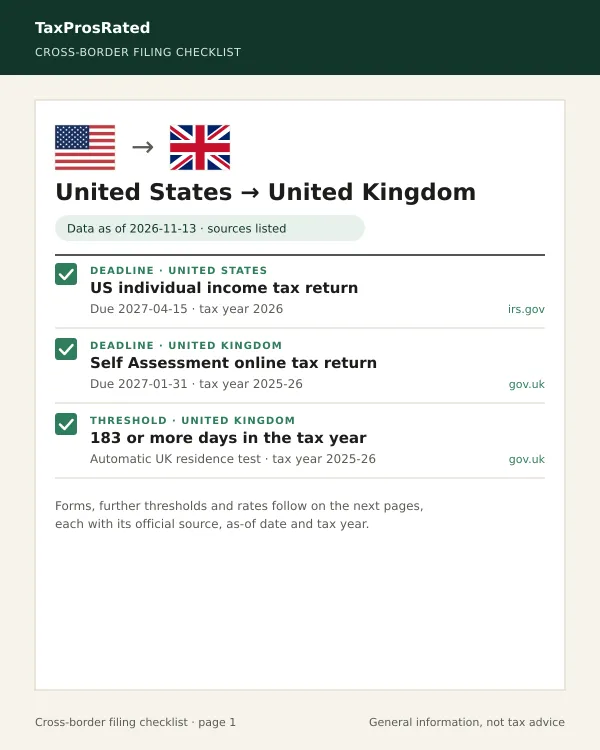
From TaxProsRated · our own product
Cross-border filing checklist
- A PDF and a web copy of the checklist for the country pair you choose
- Filing deadlines for both countries, each with the official source URL and as-of date
- The forms named by each tax authority, with a link to the authority's own page
$29 one-time · One payment, no renewal. Tax, if any, is shown at checkout.
More countries in this region · All jurisdictions · Belize filing deadlines · Belize in the tax rates index · Cross-border filing checklist
Change log
- Country summary updated
- Reviewed against Belize Tax Service Department
Sources
The figures, dates, and rules on this page are sourced from the documents listed below. Where two sources disagree, both are listed.
Important disclaimer
Informational only — not tax advice. This page summarises publicly available information about tax in Belize as of November 2026. Tax laws change, individual circumstances vary, and the application of any rule depends on your specific facts.
TaxProsRated does not provide tax, legal, accounting, or financial advice. Before acting on anything you read here, consult a qualified tax professional licensed in your jurisdiction (in the US: CPA, Enrolled Agent, or attorney; in the UK: CIOT- or ATT-qualified adviser; in Australia: TPB-registered tax agent; elsewhere: a locally-licensed equivalent). TaxProsRated, its operators, and its contributors disclaim all liability for action taken in reliance on this page.