
Country
Tax in Canada Sourced summary, not advice.
 Tax in Canada Sourced summary, not advice.
The Canada Revenue Agency (CRA) administers federal tax. Quebec residents also file a separate Revenu Québec return. The tax year is the calendar year. The T1 General is due 30 April (15 June for self-employed, but tax owed still 30 April). Tax in Canada is administered by Canada Revenue Agency (CRA).
Tax rates
Corporate income tax
Federal net general rate (basic 38% less abatement and general reduction); 9% small business rate; provincial tax extra; page states no year
Top personal income tax
Federal only; provincial or territorial tax applies in addition
Lowest personal income tax
Federal only; provincial or territorial tax applies in addition
VAT / GST (standard)
Federal GST of 5% (row for Alberta, a non-HST province with 0% PST); HST provinces charge 13-15%, others add PST; page states no year
Capital gains
Federal; only the taxable part of a gain (inclusion rate 1/2) is added to income; guide is titled Capital Gains - 2025 but the sentence names 2024
Rate table
CSV| Tax | Rate | As of | Source |
|---|---|---|---|
| Corporate income tax | 15Federal net general rate | CRA | |
| Top personal income tax | 33Federal only | CRA | |
| Lowest personal income tax | 14Federal only | CRA | |
| VAT / GST (standard) | 5Federal GST of 5% | CRA | |
| Capital gains | taxed as incomeFederal | CRA |
CA notes on this page are the question-and-answer record already researched for CA. Read the cited government page before treating a figure as current, and speak with a qualified professional in CA about a filing.
Capital gains arise when property is sold for more than its adjusted cost base. Canada does not impose a separate capital gains tax. Instead, the Income Tax Act (ITA) requires a portion of each capital gain to be included in taxable income, where it is subject to ordinary federal and provincial marginal rates. That portion is the inclusion rate, which has been 50 percent since 2000 (Canada Revenue Agency, T4037 Capital Gains guide, 2025 edition).
See also the Canada country overview for the full individual income-tax rate structure.
How are capital gains taxed in Canada?
When a capital property is sold, the capital gain is calculated as proceeds of disposition minus the adjusted cost base and any outlays or expenses of sale. One half of that gain — the taxable capital gain — is added to other income on T1 Schedule 3 and then to line 12700 of the T1 return (CRA, Completing Schedule 3, canada.ca). The resulting income stacks on top of employment or business income and is taxed at whatever combined federal-provincial marginal bracket applies.
A filer in the top federal bracket with a CAD 100,000 capital gain reports CAD 50,000 of taxable capital gain, adding CAD 16,500 in federal tax at 33 percent before provincial tax.
What is the inclusion rate, and is it 50 percent or 66.67 percent?
The inclusion rate is 50 percent for all capital gains realized by individuals, corporations, and trusts for 2025 and 2026. The April 2024 federal budget proposed raising the rate to 66.67 percent on individual gains above CAD 250,000 per year and on all corporate and trust gains effective June 25, 2024. The Canada Revenue Agency began administering the proposed higher rate in mid-2024. On January 31, 2025, the Department of Finance deferred implementation to January 1, 2026. The 50 percent rate was restored retroactively, and no individual faces the 66.67 percent rate for any period.
Sponsored. We may earn a commission if you sign up through these links, at no cost to you. How we earn

The effective capital gains tax rate at the top combined federal-provincial bracket varies by province. With a 50 percent inclusion rate, the effective rate is exactly half the top combined marginal rate for ordinary income.
| Province or Territory | Top combined marginal rate (ordinary income) | Effective capital gains rate (50% inclusion) |
|---|---|---|
| Newfoundland and Labrador | 54.80% | 27.40% |
| Nova Scotia | 54.00% | 27.00% |
| Ontario | 53.53% | 26.77% |
| British Columbia | 53.50% | 26.75% |
| Quebec | 53.31% | 26.66% |
| New Brunswick | 52.50% | 26.25% |
| Prince Edward Island | 51.37% | 25.69% |
| Manitoba | 50.40% | 25.20% |
| Alberta | 48.00% | 24.00% |
| Saskatchewan | 47.50% | 23.75% |
| Northwest Territories | 47.05% | 23.53% |
| Yukon | 48.00% | 24.00% |
| Nunavut | 44.50% | 22.25% |
Source: TaxTips.ca, Canada top marginal tax rates by province, 2025 (citing CRA and Finance Canada data).
Did the proposed 2024 inclusion-rate increase take effect?
No. The 66.67 percent inclusion rate never became law. The CRA reverted to 50 percent for all periods. Filers who submitted returns or instalments based on the 66.67 percent rate were entitled to adjustment or refund.
Is the gain on my home exempt from tax?
A capital gain on the disposition of a qualifying principal residence is generally fully exempt under ITA section 40(2)(b), the Principal Residence Exemption (PRE). The key conditions, as set out by the CRA on its Principal Residence and Other Real Estate page, are:
- The property was ordinarily inhabited during the year by the taxpayer, their spouse or common-law partner, former spouse, or child.
- Only one property per family unit can be designated as principal residence for any given year. A family unit includes the taxpayer plus spouse or common-law partner plus unmarried children under 18.
- The exempt land area is generally limited to the building plus up to 0.5 hectares; larger lots may claim only the portion necessary for the use and enjoyment of the housing unit.
- The PRE must be claimed by completing Form T2091 (Designation of a Property as a Principal Residence) attached to T1 Schedule 3 in the year of sale. This reporting has been mandatory since the 2016 tax year.
A partial PRE applies when the property was not designated for every year of ownership — for example, where it was rented for a period. The exempt portion of the gain is calculated as: (years designated plus 1) divided by total years owned, multiplied by the total gain. The additional year accounts for the year of acquisition.
Since January 1, 2023, a gain on a residential property held for fewer than 365 days is generally treated as fully taxable business income, not a capital gain, unless a listed life-event exception applies (CRA, Principal Residence page). Eligible exceptions include death, divorce, birth of a child, disability, or employment relocation.
A qualified tax professional familiar with Canadian real estate transactions can review whether a specific disposition meets PRE eligibility. A CPA licensed in your province can apply these rules to your position; the credential-check page links the official registers for checking a designation.
Capital gains tax in Canada: 50% inclusion rate, principal residence exemption, and LCGE
Canada taxes capital gains not as a separate tax but by including half the gain in taxable income at the filer's marginal rate. The inclusion rate is 50 percent for 2025 and 2026 — a proposed increase to 66.67 percent was cancelled in March 2025. The principal residence exemption eliminates tax on a qualifying primary home sale. The Lifetime Capital Gains Exemption shields up to CAD 1.25 million on qualifying small business or farm property.
What is the capital gains inclusion rate in Canada for 2025 and 2026?
The inclusion rate is 50 percent for both years. One half of each capital gain is added to taxable income. The April 2024 federal budget proposed raising this to 66.67 percent for individual gains above CAD 250,000 and for all corporate gains, but that proposal was cancelled by the federal government on March 21, 2025, before it became law.
How is capital gains tax calculated in Canada?
The capital gain equals the proceeds of disposition minus the adjusted cost base and selling costs. Half of that gain (the taxable capital gain) is added to other income on T1 Schedule 3 and taxed at the filer's combined federal and provincial marginal rate. The effective tax rate on the gain therefore ranges from roughly 22 to 27 percent at the top provincial brackets, depending on the province.
Does the principal residence exemption fully eliminate capital gains tax on a home sale?
Yes, if the property qualifies for every year of ownership. A home sold at a gain is fully exempt if it was the seller's principal residence for each year owned. A partial exemption applies if the home was rented or otherwise not designated for some years. The gain must still be reported on Form T2091 and T1 Schedule 3; failure to report can disallow the exemption.
What is the Lifetime Capital Gains Exemption and how much is it for 2025?
The Lifetime Capital Gains Exemption (LCGE) under ITA section 110.6 allows individuals to exclude up to CAD 1.25 million of capital gains from taxable income on the sale of Qualified Small Business Corporation shares, qualified farm property, or qualified fishing property. The CAD 1.25 million limit, raised from approximately CAD 1,016,836 in 2024, is indexed to inflation for years after 2025.
How are capital losses treated under Canadian tax law?
Allowable capital losses (50 percent of the actual loss) offset taxable capital gains in the same year. Net capital losses may be carried back three years or carried forward indefinitely against future capital gains. They generally cannot offset other types of income, with one exception: net capital losses may be applied against any income on a deceased person's final T1 return.
How does the CRA classify cryptocurrency?
The Canada Revenue Agency (CRA) treats cryptocurrency as a commodity for income tax purposes -- not as currency and not as a financial instrument [1]. This classification, first articulated administratively by the CRA in 2014 and reinforced through subsequent guidance, has significant downstream consequences: every disposal of a crypto-asset is treated as a sale of property rather than a currency exchange, and gains or losses must be calculated in Canadian dollars (CAD) at the fair market value on the date of each transaction [2].
The commodity classification means the Income Tax Act (ITA) applies in full, including the identical-property pooling rule under ITA section 47, the superficial-loss rule under ITA section 54, and the barter-transaction rules that govern crypto-to-crypto swaps and crypto-for-goods transactions.
Capital gains or business income: what determines which rate applies?
The most consequential question in Canadian crypto taxation is whether a disposal produces a capital gain -- where only 50% of the gain is included in income -- or business income -- where 100% of the gain is taxable at marginal rates. The CRA evaluates this on a facts-and-circumstances basis using common-law factors established in Friesen v. Canada (1995) and Vancouver Art Metal Works v. Canada (1993) [3]:
What events constitute a taxable disposition?
The following events trigger a disposition under CRA rules and require the taxpayer to calculate and report a gain or loss [2]:
- Sale for fiat currency (CAD, USD, or any other government-issued currency): A disposal at the CAD fair market value on the date of sale.
- Exchange for another cryptocurrency (crypto-to-crypto swap): Treated as a barter transaction. The taxpayer disposes of the first coin at its CAD fair market value on the swap date, recognising a gain or loss against its Adjusted Cost Base (ACB). The second coin acquired takes an ACB equal to that same fair market value. Canada offers no like-kind exchange deferral equivalent.
- Spending crypto on goods or services: Also a barter transaction. The taxpayer is treated as disposing of the crypto at the CAD fair market value of the goods or services received (or of the crypto itself, whichever is more readily ascertainable). The vendor includes that amount in income [4].
- Gifting crypto: Treated as a disposition at fair market value under ITA section 69 for non-arm's-length transfers. The recipient's ACB equals that fair market value. Transfers to a spouse or common-law partner qualify for the section 73(1) rollover deferral unless the donor elects out.
Non-taxable events include purchasing crypto with fiat (only establishes ACB), wallet-to-wallet transfers between addresses the same taxpayer beneficially owns, and intra-spousal transfers using the rollover.
Mining: business income or other income?
The CRA's position, reflected in its Cryptocurrency Guide, is that crypto mining activities typically constitute carrying on a business, regardless of scale. Factors pointing to business classification include the use of dedicated hardware, systematic operation to produce coins, a clear profit motive, and the deductibility of operating costs (electricity, hardware depreciation under CCA Class 50 at 55%, internet, shared home-office expenses) [1].
For business-classified miners, the fair market value of coins received on the date of receipt is reported as gross business income on Form T2125. That same fair market value becomes the ACB for the coins going forward; any subsequent increase or decrease in value upon disposal produces a separate business gain or loss (or capital gain or loss, depending on whether the miner held the coins as inventory or capital property post-receipt).
Hobby mining -- small-scale, non-profit-motivated activity -- may be treated as miscellaneous other income at receipt with a zero cost base, or in limited circumstances as non-taxable. The CRA has not issued bright-line guidance on the hobby boundary for miners, making this a judgment call that often benefits from documented evidence of intent and scale.
Staking rewards follow similar logic. The CRA has not issued specific staking guidance, but practitioner consensus treats staking rewards as income (business or property) at fair market value on the date of receipt, with the receipt-day value becoming the ACB for future disposals [2].
How does the superficial-loss rule apply to crypto?
Under ITA section 54 (the superficial-loss rule), a capital loss is denied if the taxpayer -- or an affiliated person such as a spouse or a corporation the taxpayer controls -- acquires an identical property within the period beginning 30 days before and ending 30 days after the disposition, and the identical property is still held at the end of that 30-day post-sale window [3].
Crypto Taxation in Canada: CRA Rules on Capital Gains, Business Income, and Dispositions
The Canada Revenue Agency treats cryptocurrency as a commodity, not currency. Disposing of crypto -- by sale, exchange, or spending -- triggers either a capital gain at the 50% inclusion rate or fully taxable business income, depending on your activity. Mining rewards are typically business income at fair market value on receipt. The 50% inclusion rate remains in force for 2026; the proposed 66.7% increase was cancelled in March 2025.
How does the CRA classify cryptocurrency for tax purposes?
The Canada Revenue Agency treats cryptocurrency as a commodity, not as currency or a financial instrument. Every disposal -- whether a sale for Canadian dollars, an exchange for another coin, or a purchase of goods -- is a taxable event requiring the taxpayer to calculate a gain or loss in CAD at the fair market value on the transaction date. The classification is consistent across all crypto-assets including Bitcoin, Ether, and stablecoins.
What is the capital gains inclusion rate for crypto in Canada in 2026?
The capital gains inclusion rate is 50% for 2026. A proposed increase to 66.7% on gains above CAD 250,000 was announced in the 2024 federal budget, deferred in January 2025, and formally cancelled by Prime Minister Carney on March 21, 2025. The 50% rate -- meaning half of a capital gain is added to taxable income -- has been the law continuously and was never changed by legislation.
Are crypto-to-crypto swaps taxable in Canada?
Yes. Exchanging one cryptocurrency for another is a barter transaction under CRA rules. The taxpayer disposes of the first coin at its fair market value in CAD on the swap date, triggering a capital gain or loss against its Adjusted Cost Base. The second coin acquired takes an ACB equal to that same fair market value. Canada has no like-kind exchange deferral, so every swap -- including DeFi token trades -- is a reportable disposal.
How are crypto mining rewards taxed in Canada?
The CRA's position is that mining activities typically constitute carrying on a business, regardless of scale. Business-classified miners report the fair market value of coins received on the date of receipt as gross business income on Form T2125, deduct eligible expenses (electricity, hardware depreciation, internet), and pay self-employed CPP contributions on net income. The receipt-day fair market value becomes the ACB for future disposals of the mined coins.
What is the superficial-loss rule and how does it apply to cryptocurrency?
The superficial-loss rule under ITA section 54 denies a capital loss when the taxpayer or an affiliated person acquires the identical property within 30 days before or after the sale and still holds it 30 days after the sale. For crypto, identical property means the same coin or token on any exchange or wallet. The denied loss is added to the ACB of the repurchased coins, deferring rather than permanently eliminating the deduction.
More on Canada
The rest of the Canada reference is on the Canada tax guide, in 3 parts: part 1, part 2, part 3.
- How does the Canadian dividend tax system work?
- What is the difference between eligible and non-eligible dividends?
- How is interest income taxed in Canada?
- How are capital gains on investments taxed?
- How do the TFSA and RRSP affect investment taxation?
- How are foreign dividends and foreign investment income taxed?
- Dividend and Investment Tax in Canada: Gross-Up, DTC, TFSA, RRSP, and Capital Gains
- What is the eligible dividend gross-up and federal dividend tax credit rate in Canada for 2025?
- What is the non-eligible dividend gross-up and dividend tax credit rate for small-business CCPC dividends?
- Are TFSA earnings and withdrawals tax-free in Canada?
- What is the Canadian capital gains inclusion rate for 2025 and 2026?
- Can Canadian residents claim the dividend tax credit on foreign dividends?
- How does the CRA determine whether someone is a factual resident?
- What weight does the CRA assign to each type of residential tie?
- What is the 183-day sojourner rule and who does it affect?
- How do tax treaties create deemed non-resident status?
- What income tax do Canadian residents owe and at what rates?
- What is departure tax and how is it triggered on emigration?
- What are Forms NR73 and NR74 and when are they used?
- Canadian expat tax residency: residential ties, the 183-day rule, departure tax, and Forms NR73 and NR74
- Is Canadian tax residency determined by a fixed number of days in Canada?
- What happens if a person spends 183 or more days in Canada without maintaining residential ties?
- How does a bilateral tax treaty make someone a deemed non-resident of Canada?
- What is departure tax and which assets does it apply to when leaving Canada?
- What is Form NR73 and is the CRA's residency determination binding?
- Does Canada have an inheritance or estate tax?
- What is deemed disposition at death?
- How does the spousal rollover work?
- How are RRSPs and RRIFs treated at death?
- What are provincial probate fees?
- Gifting property during your lifetime
- Canada estate and inheritance tax: deemed disposition, spousal rollover, RRSP/RRIF at death, and provincial probate fees
- Does Canada have an estate tax or inheritance tax?
- What is the deemed disposition at death in Canada?
- How are RRSPs and RRIFs taxed when the account holder dies?
- What probate fees apply to estates in Canada?
- Does Canada have a gift tax, and what happens when you give away appreciated property?
- How does Canadian municipal property tax work?
- What is Land Transfer Tax and who pays it?
- What happened to the Underused Housing Tax?
- What provincial vacancy and speculation taxes apply?
- How do foreign-buyer restrictions and taxes apply?
- Canadian property tax: municipal rates, land transfer tax, UHT elimination, and vacancy taxes
- How is the annual property tax bill calculated in Canada?
- Which provinces have Land Transfer Tax, and is there a rebate for first-time buyers?
- Is the Underused Housing Tax (UHT) still in effect?
- What is BC's Speculation and Vacancy Tax and who must file?
- Can non-Canadians currently buy residential property in Canada?
- How does a self-employed person report business income in Canada?
- What are the 2025 federal income tax rates that apply to self-employment income?
- How do Canada Pension Plan contributions work for the self-employed?
- When is GST/HST registration required for the self-employed?
- What are the filing deadlines and instalment requirements for self-employed Canadians?
- Self-Employed Tax in Canada 2025: T2125, CPP, GST/HST, and Filing Deadlines
- What form does a self-employed Canadian file to report business income?
- What is the 2025 federal income tax rate on self-employment income in Canada?
- How much CPP does a self-employed person in Canada pay in 2025?
- When does a self-employed person in Canada have to register for GST/HST?
- When is the filing deadline for self-employed Canadians, and when is tax owing due?
- What is the Small Business Deduction and who qualifies?
- How do the passive-income clawback and taxable-capital grind reduce the SBD?
- What are the combined federal-provincial small-business corporate rates?
- How does GST/HST registration work for small businesses?
- How do sole proprietors report business income?
- What are the payroll source-deduction obligations for employers?
- Small business tax in Canada: CCPC, Small Business Deduction, GST/HST, and payroll obligations
- What is the federal corporate tax rate for a CCPC on its first CAD 500,000 of active business income?
- How does the passive-income clawback reduce the Small Business Deduction?
- When must a Canadian small business register for GST/HST?
- How does a sole proprietor report self-employment income in Canada?
- What is the taxable-capital grind on the Small Business Deduction?
- What does Canada's network of tax treaties actually do?
- How does the foreign tax credit (Form T2209) work for Canadian residents?
- What Part XIII withholding rates apply to non-residents, and how does Form NR301 reduce them?
- How does the residency tie-breaker work when someone is a resident of both Canada and a treaty country?
- What are the Canada-US Convention's special rules for RRSPs, pensions, and social security?
- Canada Tax Treaty Relief: Foreign Tax Credits, Reduced Withholding, and the Canada-US Convention
- How many income tax treaties does Canada have in force?
- What is Form T2209 and what does it calculate?
- What is the default Canadian withholding tax rate for non-residents, and how do treaties lower it?
- What happens when someone is a tax resident of both Canada and a treaty country?
- How does the Canada-US treaty treat RRSPs for US residents and US Social Security for Canadian residents?
- How does the federal GST work in Canada?
- What are the GST, HST, and provincial sales tax rates by province?
- When must a business register for GST/HST?
- What is the difference between zero-rated and exempt supplies?
- How does the GST/HST return work and what are Input Tax Credits?
- Canada GST/HST and Provincial Sales Tax: Rates, Thresholds, and Compliance
- What is the GST rate in Canada and which provinces have HST?
- What provincial sales tax do BC, Saskatchewan, Manitoba, and Quebec charge?
- When does a Canadian business have to register for GST/HST?
- What are zero-rated supplies under Canadian GST/HST?
- How are GST/HST Input Tax Credits claimed and what records are required?
Frequently asked
Who is the tax authority in Canada?
The Canada Revenue Agency (CRA) administers federal tax for the Government of Canada and most provinces. Revenu Québec administers Quebec personal income tax and the QST — Quebec residents file two returns. Alberta and Quebec administer their own corporate tax; the CRA handles provincial corporate tax elsewhere.
What is the Canadian tax year and the filing deadline?
The tax year is the calendar year. T1 General returns are due 30 April. Self-employed filers have until 15 June to file, but tax owed is still due 30 April. Corporations file T2 within six months of fiscal year-end. Quarterly instalments apply where net tax exceeds CAD 3,000.
How is Canadian tax residency determined?
Residency is decided primarily by Common Law residential-ties analysis — dwelling, spouse, and dependants in Canada are primary ties. The sojourner rule deems residency at 183 days. Departure tax under section 128.1 applies on emigration, with deemed disposition of most assets at fair market value.
What are the Canadian personal income tax rates?
Federal brackets for 2025: 15% up to CAD 57,375, 20.5% to 114,750, 26% to 177,882, 29% to 253,414, 33% above. Provincial rates apply in addition — combined top rates exceed 50% in most provinces (53.5% in Ontario, 54% in BC, 53% in Quebec). Basic personal amount approximately CAD 16,129 for 2025.
How does Canadian corporate tax work?
Federal general corporate rate is 15%. The Small Business Deduction reduces the federal rate to 9% on the first CAD 500,000 of active business income for a Canadian-Controlled Private Corporation, subject to a passive-investment-income clawback above CAD 50,000. Combined federal-plus-provincial rates run 23–31%.
How does indirect tax work in Canada?
Federal GST is 5%. Five provinces operate the HST (13% in Ontario; 15% in NL, NB, NS, PEI). BC, SK, MB run separate PST alongside GST; Quebec runs QST at 9.975% via Revenu Québec. Mandatory GST/HST registration threshold is CAD 30,000 of worldwide taxable supplies in any 12-month period.
From TaxProsRated · our own product
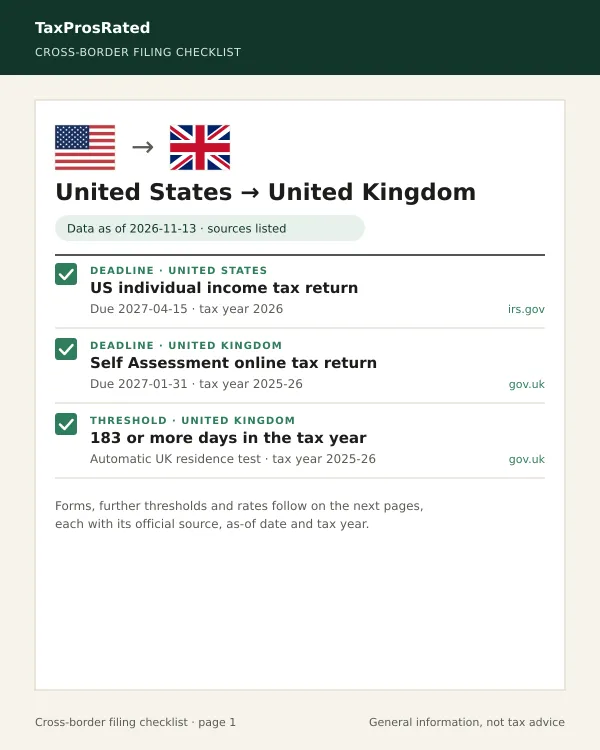
Cross-border filing checklist
- A PDF and a web copy of the checklist for the country pair you choose
- Filing deadlines for both countries, each with the official source URL and as-of date
- The forms named by each tax authority, with a link to the authority's own page
$29 one-time · One payment, no renewal. Tax, if any, is shown at checkout.
More countries in this region · All jurisdictions · Canada filing deadlines · Canada in the tax rates index · Canada vs United States · Cross-border filing checklist
Canada tax guides
In-depth guides and explainers relevant to Canada.
- CanadaCanada Income Tax Return: CRA BasicsWho must file a Canadian personal tax return, what income and deductions go on it, how and when to file with the CRA, and what happens next.
- CanadaCanada tax season: filing your T1 returnThe T1 General income tax return explained: what slips you need, the 30 April and 15 June deadlines, how NETFILE works, and what to expect after assessment.
- CanadaRRSP vs TFSA: the basicsThe key differences between Canada's RRSP and TFSA registered accounts: when tax applies, how contribution room works, the RRSP deadline window, and which situations suit each account.
- CanadaHow to verify a tax professional's credentialsBefore sharing your financial records, confirm your preparer's credentials. Here is how to check official registers in the US, UK, Canada, and Australia.
Change log
- Country summary updated
- Rate source updated: capital-gains Source
- Rate source updated: corporate-income Source
- Rate source updated: vat Source
- Rate source updated: personal-income-lowest Source
- Rate source updated: personal-income Source
- Rate source updated: inheritance
- Rate updated: capital-gains 50% inclusion->taxed as income Source
- Rate updated: corporate-income from 15% to 15 Source
- Rate updated: vat from 5% to 5 Source
- Rate added: personal-income-lowest 14 Source
- Rate updated: personal-income from 33% to 33 Source
- Country summary updated
- Reviewed against Canada Revenue Agency (CRA)
Sources
The figures, dates, and rules on this page are sourced from the documents listed below. Where two sources disagree, both are listed.
Important disclaimer
Informational only — not tax advice. This page summarises publicly available information about tax in Canada as of November 2026. Tax laws change, individual circumstances vary, and the application of any rule depends on your specific facts.
TaxProsRated does not provide tax, legal, accounting, or financial advice. Before acting on anything you read here, consult a qualified tax professional licensed in your jurisdiction (in the US: CPA, Enrolled Agent, or attorney; in the UK: CIOT- or ATT-qualified adviser; in Australia: TPB-registered tax agent; elsewhere: a locally-licensed equivalent). TaxProsRated, its operators, and its contributors disclaim all liability for action taken in reliance on this page.